
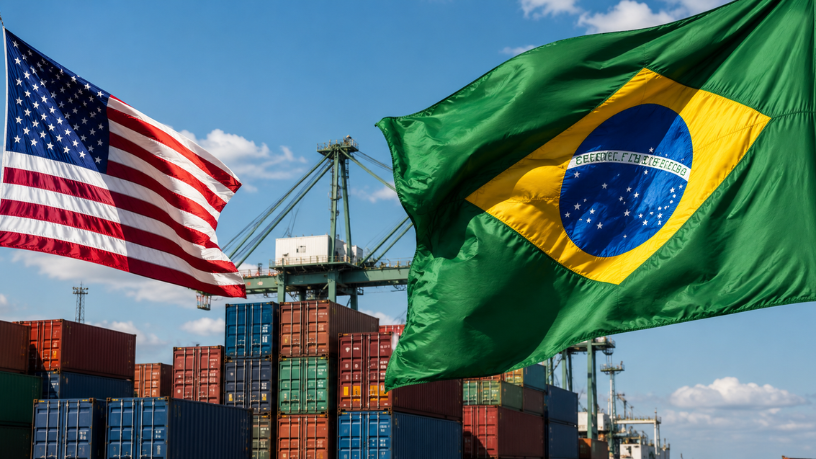
A hearing in Washington brings the United States closer to deciding on new tariffs, drawing the attention of Brazilian companies that rely on the American market.
Trade negotiations between Brazil and the United States have once again become a major focus this week. Over the past few days, representatives from the Brazilian government, business organizations, and industrial sectors have participated in public hearings held by the Office of the United States Trade Representative (USTR) in Washington in an effort to prevent the implementation of new tariffs on Brazilian products. A final decision is expected in the coming days and could influence everything from Brazilian exports to the value of the U.S. dollar and investment flows.
Although the discussions are taking place in the United States, their effects could quickly be felt in Brazil. The U.S. remains one of the largest destinations for Brazilian exports, particularly manufactured and higher-value-added goods. As a result, any changes to trade rules immediately attract the attention of businesses, investors, and workers connected to international commerce.
The issue has also gained political importance because it involves broader debates over trade practices, technological innovation, payment systems, and international competitiveness. For readers in Brazil, the key question is straightforward: which industries could be affected, and what would actually change if the proposed tariffs are approved?
Why Are the United States Considering New Tariffs on Brazilian Products?
The current debate stems from an investigation conducted by the USTR under Section 301 of U.S. trade law, a legal mechanism used to examine foreign trade practices considered unfair to American interests. U.S. officials are reviewing several aspects of the bilateral trade relationship and evaluating the possibility of imposing tariffs of up to 25% on a range of Brazilian products, although some strategically important goods remain excluded from the initial proposal.
During this week’s public hearings, Brazilian representatives argued that the trade relationship between the two countries has historically been complementary and that additional tariffs could negatively affect both American and Brazilian businesses. Industry groups emphasized that many Brazilian exports serve as essential inputs for U.S. manufacturers, meaning higher import costs could ultimately increase production expenses for American companies before reaching consumers.
Another important aspect involves the proposed exemptions. Products such as coffee, beef, rare earth minerals, and certain aerospace components have been listed among the items initially excluded from the tariff proposal, reducing the potential impact on several key sectors of Brazil’s economy. Nevertheless, many industrial exporters continue to monitor negotiations closely until the U.S. government issues its final decision.
How Could This U.S. Decision Affect Brazilian Companies and the Dollar?
Financial markets are watching these negotiations carefully because changes in trade policy often influence expectations regarding economic growth, international trade, and global investment. If Brazilian exports become less competitive in the United States, exporting companies could face lower profit margins, the need to diversify into new markets, or pressure to renegotiate commercial contracts.
At the same time, weaker export performance could indirectly affect Brazil’s exchange rate. While numerous factors determine the value of the U.S. dollar against the Brazilian real, trade uncertainty frequently increases market volatility. Companies that depend on imported components may also experience higher production costs if exchange rate fluctuations intensify.
The negotiations come at a time when the U.S. economy itself remains under close observation. Economic data released this week showed that the U.S. trade deficit widened in May, driven largely by increased imports of capital goods and artificial intelligence-related equipment. The figures reinforce that trade policy remains one of Washington’s primary tools for addressing trade imbalances while supporting strategic domestic industries.
What Businesses and Investors Should Watch in the Coming Days
Attention is now focused on the USTR’s final decision, which is expected in the coming days. Until then, U.S. officials will continue reviewing testimony presented during the public hearings, along with comments submitted by businesses, trade associations, and foreign governments. There remains the possibility that the original proposal could be modified through additional exemptions, revised tariff rates, or other adjustments.
For Brazilian exporters, this is a period of careful monitoring. Depending on the outcome, companies may need to reassess contracts, commercial strategies, and revenue forecasts for the second half of the year. American companies are also closely following the process, particularly manufacturers that rely on Brazilian raw materials and intermediate goods in their supply chains and have advocated for tariff exemptions to avoid increased production costs.
For Brazilian consumers, any effects would likely be indirect and gradual. Changes in the exchange rate, export performance, and investor confidence generally appear before noticeable impacts on consumer prices or economic activity. As a result, the U.S. decision will be watched not only by exporters but also by financial analysts, investors, policymakers, and economists in both countries.
This episode highlights how trade relations between Brazil and the United States continue to play a significant role in shaping the economies of both nations. Even when policy debates take place in Washington, decisions involving tariffs, international trade, and industrial competitiveness can quickly influence Brazil’s business environment. The outcome of the negotiations in the coming days will help determine whether bilateral trade continues on a cooperative path or enters a new period of heightened commercial tension.
Fontes oficiais
- Office of the United States Trade Representative (USTR) – Public Hearing on Proposed Responsive Action in the Section 301 Investigation of Brazil
https://ustr.gov/about/policy-offices/press-office/press-releases/2026/july/public-hearing-proposed-responsive-action-section-301-investigation-certain-acts-policies-and - USTR – Section 301 Investigation: Brazil’s Acts, Policies, and Practices
https://ustr.gov/trade-topics/enforcement/section-301-investigations/section-301-brazils-acts-policies-and-practices-related-digital-trade-and-electronic-payment - USTR – Section 301 Determination on Brazil’s Unreasonable Acts, Policies, and Practices (June 1, 2026)
https://ustr.gov/about/policy-offices/press-office/press-releases/2026/june/ustr-section-301-determination-brazils-unreasonable-acts-policies-and-practices - Federal Register – Notice of Determination and Request for Comments
https://www.federalregister.gov/documents/2026/06/04/2026-11158/notice-of-determination-and-request-for-comments-concerning-action-pursuant-to-section-301-brazils