
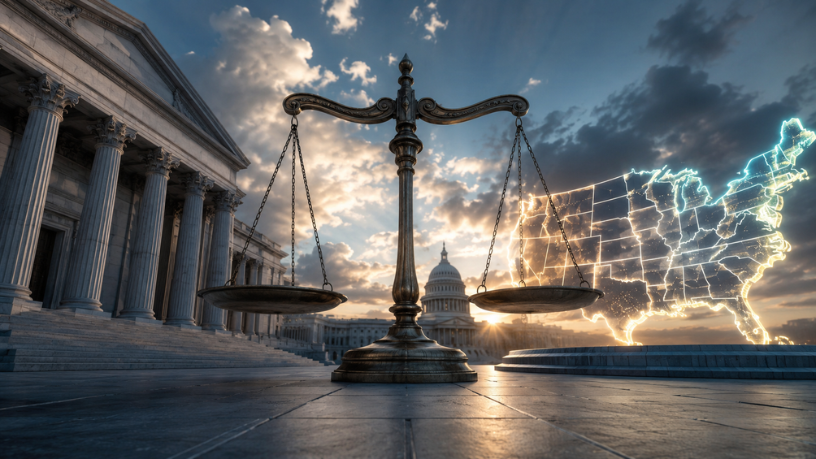
With no unified federal law in place, the clash between Washington and state capitals is creating one of the most unpredictable compliance landscapes in U.S. history.
The United States is in the middle of one of the most consequential regulatory fights of the digital era — and the outcome will determine how artificial intelligence is built, deployed, and governed for the next decade. At the heart of the dispute is a question that touches every company using AI in hiring, healthcare, finance, or consumer services: which rules actually apply to you?
As of June 2026, there is still no comprehensive federal AI law. Instead, companies face a growing patchwork of state-level regulations that went into effect on January 1, 2026 — while a White House executive order from June 2, 2026 pushes aggressively to centralize AI oversight at the federal level and override many of those state laws. The tension between those two forces is not just a legal abstraction. For developers, deployers, and businesses that rely on AI-driven decision-making, it translates into real uncertainty about what compliance looks like right now.
Understanding the stakes requires looking at both sides of this standoff: what the states have actually enacted, what the federal government is trying to do about it, and what organizations operating AI systems should be thinking about in the meantime.
What the states have already put into law
California led the charge with a trio of laws that took effect at the start of this year. The Transparency in Frontier AI Act (SB 53) requires developers of large frontier models to publish risk frameworks, report critical safety incidents, and implement whistleblower protections, with penalties reaching $1 million per violation for companies with annual revenue exceeding $500 million. A second law, the AI Training Data Transparency Act (AB 2013), mandates that developers of generative AI systems publish summaries of their training datasets, including data sources, types, intellectual property information, and personal information details. Baker BottsWilson Sonsini Goodrich & Rosati
Texas and Illinois also moved quickly. Texas enacted the Responsible AI Governance Act on January 1, 2026, which imposes categorical bans on AI systems designed for behavioral manipulation, unlawful discrimination, violence incitement, or deepfake production of child sexual abuse material, and restricts state entities from using AI for social scoring or biometric identification without consent. Illinois, meanwhile, requires employers to notify job candidates when AI analyzes video interviews, obtain consent before AI evaluation occurs, and follow data retention rules — provisions that took effect in February 2026. VerifyWiseVerifyWise
Colorado’s story is more complicated. The state passed what was originally the most comprehensive state-level AI governance law in the country, targeting developers and deployers of high-risk AI systems making consequential decisions about education, employment, government services, healthcare, housing, insurance, or legal services. But after industry pushback, Colorado repealed and replaced that law in May 2026 with a narrower statute regulating automated decision-making technology, now effective January 1, 2027. The episode illustrates how much pressure the industry is placing on regulators, and how quickly the landscape can shift. VerifyWise
For businesses operating across multiple states, the compliance challenge is significant. If your organization uses AI in hiring decisions, you are likely subject to overlapping requirements from New York City’s Local Law 144, Illinois’s video interview rules, Maryland and New Jersey hiring restrictions, California’s civil rights department regulations, and federal anti-discrimination statutes. That alone represents five separate compliance frameworks for a single use case. VerifyWise
What the White House is trying to do about it
The Trump administration has made clear it wants to end the patchwork. Executive Order 14409, signed on June 2, 2026, states that the United States continues to lead in artificial intelligence because the administration refuses to stifle innovation with overly burdensome regulation, and that the administration has unleashed tremendous technological growth by slashing the bureaucratic constraints placed on AI developers by the prior administration. White House
This latest executive order builds on steps the administration had already taken. In December 2025, President Trump signed an executive order directing federal agencies to identify and challenge state AI laws deemed inconsistent with national policy, and tasking the Attorney General with coordinating litigation efforts against state measures that impose what the administration characterizes as innovation-limiting requirements. In March 2026, the White House released a four-page National Policy Framework for Artificial Intelligence, calling for federal preemption of state AI laws and arguing against the patchwork approach as an obstacle to innovation. VorysHolland & Knight
The legislative draft that accompanied those moves, the TRUMP AMERICA AI Act introduced by Senator Marsha Blackburn, would create a federal liability framework, establish a duty of care for chatbot developers, address copyright and training data, and require annual third-party audits for political bias in high-risk systems. As of now, none of those provisions are law. But they signal where the administration wants to go — and how far it is willing to push. LoopStudio
The political path is not straightforward. Democrats remain skeptical of the framework. Members such as Representatives Yvette Clarke and Don Beyer, along with Senator Brian Schatz, have raised concerns regarding federal preemption, accountability, and oversight, while Senate Commerce Ranking Member Maria Cantwell continues to advocate for a more structured approach grounded in standards, testing, and public infrastructure investment. That divide means even if the administration presses its preemption agenda through executive action, a durable legislative solution requires a bipartisan coalition that currently does not exist. Holland & Knight
What this means for organizations using AI today
The practical implication for companies is that the regulatory environment is, at best, in a state of managed uncertainty. It will fall to the courts to determine if, whether, and how the executive order will affect multiple state AI laws, including those in California, Colorado, Illinois, and Texas. Companies should maintain flexible compliance programs capable of adjusting to the shifting state and federal regulatory environment. Kslaw
That flexibility is not just a legal hedge — it is increasingly a business necessity. Companies that build their AI governance frameworks around a single state’s rules risk being blindsided when another law kicks in, or when a federal standard eventually lands and supersedes the state-level approach they have been following. The smarter path is to treat AI compliance as a dynamic, living process rather than a one-time certification.
The Federal Trade Commission has been the most active federal agency on AI enforcement, using its existing authority under Section 5 of the FTC Act to go after unfair or deceptive AI practices — and that enforcement channel remains open regardless of how the federal-state preemption fight resolves. For any organization deploying AI systems that touch consumers, that is a real and present risk that does not depend on any new legislation passing. Wilson Sonsini Goodrich & Rosati
The current moment is genuinely unprecedented. No other technology has triggered this scale of simultaneous legislative activity across dozens of states, all while the federal government is actively trying to pull the rug out from under those laws. Whatever the courts ultimately decide, the companies that come out of this period strongest will be those that stayed informed, invested in governance infrastructure, and avoided the temptation to treat regulatory uncertainty as permission to do nothing at all.
Sources: whitehouse.gov | verifywise.ai | bakerbotts.com | wsgr.com | hklaw.com | vorys.com
Autor: Diego Rodríguez Velázquez