
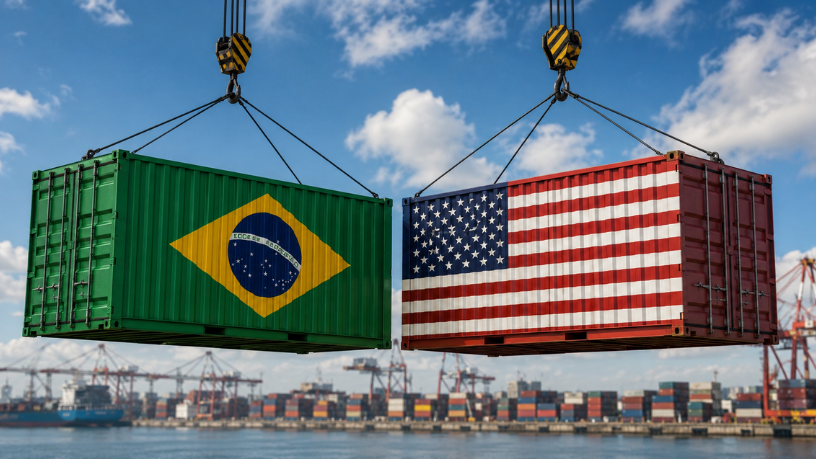
Washington is considering a 25% tariff on many Brazilian products, with potential economic, political, and technological consequences for both Brazil and the United States.
The latest trade tensions between the United States and Brazil have become one of the most significant developments in the bilateral relationship in recent weeks. The U.S. government has proposed an additional 25% tariff on many Brazilian imports following an investigation conducted by the Office of the United States Trade Representative (USTR). The inquiry focuses on several areas, including digital trade, electronic payment systems, ethanol market access, intellectual property protection, and efforts to combat illegal deforestation.
Although the proposal has not yet been finalized, it has already sparked reactions from business leaders, policymakers, and exporters on both sides. For many readers, the key question is straightforward: could these tariffs affect businesses, consumers, and the broader relationship between Brazil and the United States? The answer extends beyond trade alone. The debate now includes digital payments, technological competition, exchange rates, and even Brazil’s upcoming presidential election. A public hearing was held on July 6, and the USTR is expected to announce its final decision on July 15.
Why Is the United States Considering a 25% Tariff on Brazil?
The proposal stems from a Section 301 investigation under the U.S. Trade Act of 1974, a legal mechanism Washington uses to address what it considers unfair foreign trade practices. According to the USTR, Brazil maintains policies that may disadvantage American companies in areas such as digital services, electronic payment systems, ethanol imports, intellectual property rights, and environmental enforcement related to illegal deforestation.
The proposed measure would apply a 25% tariff to a broad range of Brazilian goods entering the U.S. market, although important exemptions have been suggested for products including coffee, beef, rare earth minerals, and certain aircraft components. If implemented, the measure would represent one of the most significant trade actions affecting Brazil in recent years.
One of the most closely watched aspects of the investigation involves Pix, Brazil’s instant payment system developed by the Central Bank of Brazil. U.S. officials argue that Brazil’s payment ecosystem may create competitive challenges for American financial technology companies and international payment networks. Brazilian authorities, however, maintain that Pix has expanded financial inclusion, reduced transaction costs, and operates as public infrastructure designed to benefit consumers and businesses. As a result, the dispute has evolved into a broader discussion about digital commerce and technological competition between two of the largest economies in the Western Hemisphere.
How Could the Tariffs Affect Brazilian Businesses and Consumers?
If approved, the tariffs could reduce the competitiveness of Brazilian exporters in the American market. A 25% increase in import costs would make many Brazilian products more expensive for U.S. buyers, potentially encouraging importers to seek alternative suppliers from other countries.
Although several strategic products may receive exemptions, manufacturers, agribusiness exporters, and industrial suppliers remain concerned about the potential economic consequences. During the recent USTR hearing, Brazilian officials and representatives of American companies argued that broad tariffs could disrupt supply chains and increase production costs for U.S. industries that rely on Brazilian inputs.
For Brazilian consumers, the effects would likely be indirect rather than immediate. Companies facing reduced exports could postpone investments, lower production, or seek compensation through domestic policy measures. Trade disputes of this magnitude also tend to influence currency markets, making the exchange rate between the U.S. dollar and the Brazilian real an important factor for businesses, travelers, and investors. In other words, a trade conflict between the United States and Brazil has implications that extend well beyond customs duties.
Why Has the Tariff Debate Become a Political Issue in Brazil?
The timing of the proposal has added another layer of complexity. Brazil is approaching its 2026 presidential election, and the trade dispute has quickly become part of the political debate.
Senator Flávio Bolsonaro traveled to Washington to advocate for delaying the proposed tariffs, arguing that the measure could harm Brazil’s economy and potentially influence the country’s political environment. Meanwhile, President Luiz Inácio Lula da Silva criticized the U.S. initiative, describing it as a matter of national sovereignty and emphasizing Brazil’s right to establish its own economic policies.
For Washington, the proposal reflects a broader strategy of using trade policy to influence international standards in areas such as digital commerce, environmental regulation, and market access. For Brazil, the challenge lies in defending its interests while preserving a constructive relationship with one of its largest trading partners and a major source of investment, technology, and innovation.
The USTR’s upcoming decision will therefore be closely monitored by exporters, financial institutions, technology companies, investors, and policymakers in both countries. Even if the proposal is modified, delayed, or narrowed through exemptions, the episode has already demonstrated that trade, technology, and geopolitics are becoming increasingly interconnected.
For international observers, the dispute represents more than a disagreement over tariffs. It highlights the growing importance of digital infrastructure, economic competitiveness, and strategic partnerships in shaping the future of U.S.–Brazil relations. The outcome could influence bilateral trade, technological cooperation, investment flows, and broader economic policy discussions for years to come.
Fontes oficiais
- U.S. Trade Representative (USTR) – Section 301 Investigation on Brazil
https://ustr.gov/trade-topics/enforcement/section-301-investigations/section-301-brazils-acts-policies-and-practices-related-digital-trade-and-electronic-payment - USTR – Section 301 Determination on Brazil (1º de junho de 2026)
https://ustr.gov/about/policy-offices/press-office/press-releases/2026/june/ustr-section-301-determination-brazils-unreasonable-acts-policies-and-practices - USTR – Public Hearing on Proposed Responsive Action (6 e 7 de julho de 2026)
https://ustr.gov/about/policy-offices/press-office/press-releases/2026/july/public-hearing-proposed-responsive-action-section-301-investigation-certain-acts-policies-and