
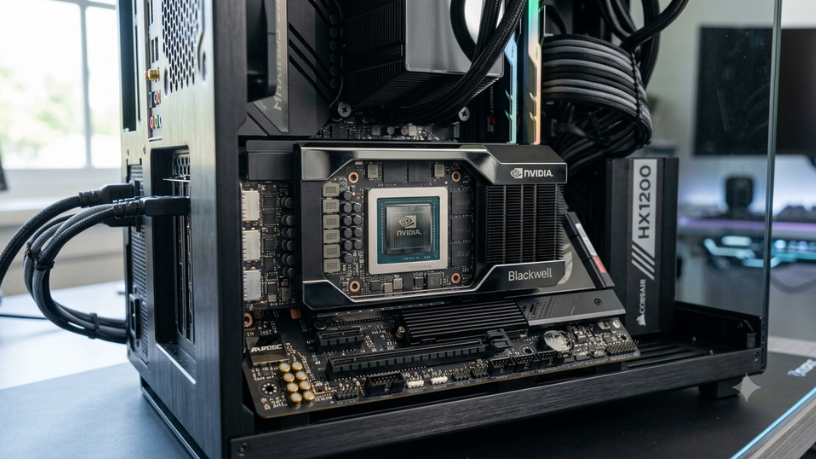
Nvidia has announced a new artificial intelligence chip designed for personal computers, a move that reinforces the growing integration between hardware and AI in everyday digital life. The initiative, described by CEO Jensen Huang as a reinvention of the computer, signals a structural shift in how personal machines process data, execute tasks, and interact with users. This article examines the technological and market impact of this innovation, along with its practical effects on home and professional computing.
The evolution of the computer into an AI-driven machine
Personal computing has gone through several phases over the past decades, from machines focused on local processing to systems heavily dependent on cloud connectivity. Nvidia’s new AI chip represents another step in this evolution by bringing advanced artificial intelligence capabilities directly into user hardware.
In practice, this means tasks that previously relied on external servers can now be executed locally with greater speed and efficiency. Natural language processing, image generation, workflow automation, and data analysis reach a new level of performance, reducing latency and increasing device autonomy.
This shift changes the traditional role of the computer, which moves from being a command execution tool to becoming an adaptive system capable of learning user patterns and optimizing its own responses.
Redefining computing architecture and market impact
Nvidia’s strategy reflects a broader trend in the technology sector: the migration of artificial intelligence from purely cloud-based environments to hybrid and local solutions. This shift has direct implications for system architecture, software design, and application development.
By integrating AI directly into the chip, performance is no longer fully dependent on external server connections. This improves energy efficiency, enhances data security, and reduces processing bottlenecks. At the same time, it puts pressure on competitors to accelerate the development of similar solutions, creating a new competitive cycle in the semiconductor industry.
The personal computer market is also likely to be affected. Laptop and desktop manufacturers will need to adapt their product lines to include AI-optimized chips, while consumers gain access to more powerful machines without requiring complex upgrades.
The concept of a reinvented computer and its practical implications
The idea of a reinvented computer goes beyond performance upgrades. It points to a conceptual shift in the relationship between users and machines. Instead of operating solely through direct commands, systems begin to anticipate needs, suggest actions, and execute tasks proactively.
This model brings personal computing closer to an integrated intelligent assistant embedded within hardware. The impact on daily workflows could be significant, especially in fields such as content creation, programming, design, and data analysis. Professionals in these areas are likely to experience productivity gains as repetitive and technical tasks become increasingly automated.
At the same time, this evolution requires cultural adaptation. Users will need a better understanding of how AI-based systems operate in order to fully benefit from their capabilities without relying entirely on traditional interfaces.
Competitive pressure and the race for AI dominance
Nvidia’s stronger push into AI chips for personal computers intensifies the global competition for technological leadership. Companies in the processor manufacturing space and operating system developers will face pressure to respond with comparable innovations.
This environment creates a race for efficiency and integration, where competitive advantage is no longer defined only by hardware power but by the ability to combine intelligent software with optimized architecture. The boundary between hardware and software becomes increasingly blurred, requiring more integrated product development approaches.
In addition, the decentralization of AI processing could reshape part of the cloud services ecosystem, which has so far dominated artificial intelligence infrastructure. This does not eliminate the importance of cloud computing, but it redistributes its role within a more hybrid model.
The future of personal computing in an AI-first environment
The arrival of dedicated AI chips for PCs signals that personal computing is entering a new stage of technological maturity. The computer is no longer just a productivity tool but is evolving into an intelligent system embedded in user behavior.
This transformation is part of a broader movement in which artificial intelligence is becoming a structural layer of digital technology. The result is a more dynamic, responsive, and adaptive computing environment.
The challenge moving forward will be balancing performance, privacy, and accessibility. As AI becomes a core component of personal devices, companies will carry greater responsibility to ensure transparency and user control. In this emerging landscape, the computer is not only evolving but also redefining its place in modern digital life.
Autor: Diego Velázquez