

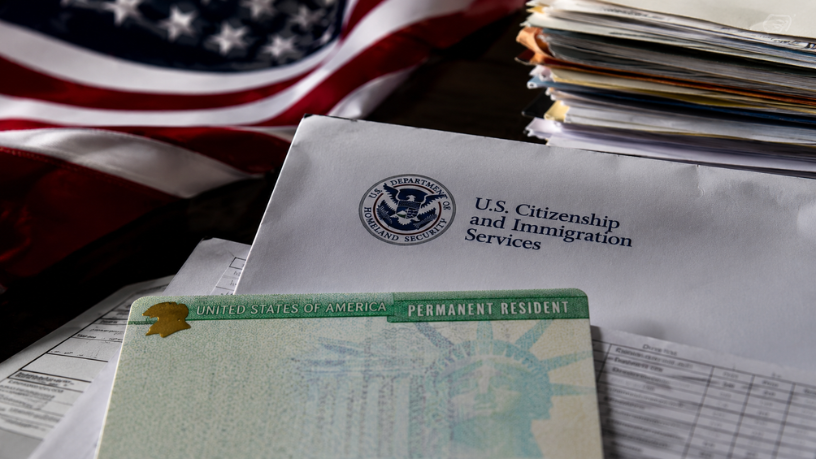
A USCIS policy memo from May 2026 has upended how hundreds of thousands of immigrants understand their path to permanent residency in the United States.
For most of its modern history, the U.S. immigration system allowed people who were already living legally in the country to apply for a green card without leaving. That process, known as adjustment of status, was how the majority of the roughly one million people who obtained lawful permanent residency each year actually went through the system. A policy memo issued on May 21, 2026 by U.S. Citizenship and Immigration Services has placed that pathway in serious doubt — and the fallout has been immediate.
The memo itself is framed as a reminder of existing law rather than new policy. But in practice, it instructs USCIS officers to treat adjustment of status as a discretionary relief that can be denied, potentially forcing applicants to leave the United States and apply for immigrant visas at a U.S. consulate abroad before returning. For many people, that requirement would mean leaving jobs, separating from families, and facing a visa appointment system that currently runs years behind in many countries.
The policy fits within a broader pattern of immigration changes that have accelerated throughout the first half of 2026. Understanding what the memo actually says — and what it does not say — matters for anyone in the immigration system, or anyone who employs or lives alongside the roughly 40 million foreign-born people who call the United States home.
What the green card memo actually says — and what remains unclear
On May 21, USCIS issued a policy memorandum concerning green card applications filed within the United States. While the Trump administration presented the memo as a reminder to USCIS employees about existing law, it also touted it as closing a loophole that could force more noncitizens to leave the country to apply for green cards. American Immigration Council
The ambiguity has been a central problem since the memo was released. After initially presenting the new policy as something that would affect most green card applications, USCIS stated that it would be implemented on a case-by-case basis, implying that many immigrants would still be able to remain in the United States while applying. However, many questions remain unanswered: what will happen to people who have already filed applications, who will face the most scrutiny, and whether any groups of noncitizens will in practice face consistent denial of adjustment of status requests. American Immigration Council
The practical consequences are already visible. There are recent reports from attorneys representing noncitizens with pending adjustment applications that their clients are being asked to demonstrate extraordinary circumstances per the memo — even though the agency has not clarified through formal policy or guidance whether the memo applies to applications that have already been filed, or only to new ones. American Immigration Council
The scale of the issue is significant. In fiscal year 2023, a total of 608,260 people obtained lawful permanent residency by adjusting their status while living in the United States — more than half of all green card recipients that year. The rest, 564,660, arrived from abroad through consular processing. If the new guidance shifts a meaningful share of future applicants into the consular track, the downstream effects on the immigration court system, U.S. consulates abroad, and individual families could be substantial. American Immigration Council
The policy has drawn particular concern from military families. DHS rescinded a 2022 policy in April 2025 that had treated a family member’s military service as a significant mitigating factor in immigration enforcement decisions, replacing it with guidance stating that military service alone does not exempt aliens from the consequences of violating U.S. immigration laws. Advocates warn that the combination of the new green card processing requirements and the removal of military family protections creates compounding vulnerabilities for mixed-status military households. Forumtogether
The broader immigration picture in mid-2026
The green card memo did not emerge in isolation. It reflects a consistent direction in immigration policy over the past eighteen months that has affected legal and unauthorized immigration alike. In January 2026, the administration suspended the approval of immigrant visas for people from 75 countries, arguing that the measure aims to ensure individuals from high-risk countries do not utilize welfare in the United States. By some estimates, the measure will block about half of all legal immigration to the U.S. Conference Board
The effect on border crossing numbers has been substantial. Government data indicate that encounters at U.S. borders declined to about 35,000 in January 2026, a 79% decline year over year. About 70,000 people are in ICE custody, up about 84% since the prior year. Conference Board
Those numbers represent real shifts in enforcement capacity and priorities. Employers in certain sectors, including healthcare, construction, hospitality, and agriculture, have raised concerns about how reduced immigration is impacting labor shortages. The concern is particularly acute because data for the first half of 2025 show nonimmigrant work visa issuance lagging by about 3% year over year, and international student enrollment at U.S. universities declined by 17% in the fall semester of 2025 — a trend that carries long-term implications for talent pipelines in sectors that have relied heavily on foreign-born workers and students. Conference BoardConference Board
Enforcement has also expanded in new directions. In late May 2026, DHS directed ICE attorneys to more aggressively pursue administrative fraud cases against immigration lawyers accused of filing false asylum claims, with the directive explicitly stating that enforcement should include action against immigration attorneys filing what the department characterizes as false claims in immigration court. The American Immigration Lawyers Association called the broader campaign against immigration attorneys “dangerous,” warning that it could reduce legal representation for asylum seekers navigating an already complex system. Forumtogether
What people in the immigration system should know right now
For individuals with pending adjustment of status applications, the most important step is consulting an immigration attorney who is current on the memo’s implementation. As a routine precaution while in the United States, immigration advocates recommend carrying hard copies of key immigration documents, including a valid Form I-20 with a current travel signature for F-1 students, and Form DS-2019 for J-1 exchange visitors. Washington University
The legal landscape around several of these policies is also actively contested. A federal judge in Boston ruled that the administration cannot stop processing immigration applications for people from countries included in the travel ban, finding that the policy is likely unlawful and unfairly targets people based on their country of origin. The ruling, however, applies only to the specific plaintiffs in that lawsuit and does not offer broader protection to similarly situated applicants. Welcome.US
The core question that remains unanswered is how USCIS will exercise the discretion that the May memo asserts in practice. USCIS has issued conflicting messaging that has created confusion and panic for applicants, employers, and practitioners, and the agency has still not formally clarified whether the memo applies to applications already filed or only to new ones. Until that clarity arrives, anyone whose immigration status depends on an adjustment of status application is navigating a system whose rules are genuinely uncertain — not by accident, but by design. American Immigration Council
Sources: uscis.gov | americanimmigrationcouncil.org | conference-board.org | forumtogether.org | forumtogether.org | oiss.washu.edu
Autor: Diego Rodríguez Velázquez