

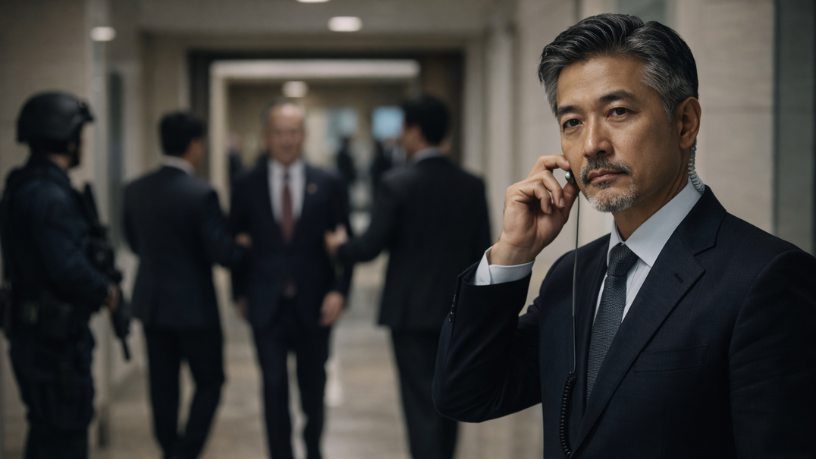
Protecting authorities requires much more than physical presence or quick reactions to unexpected situations. According to Ernesto Kenji Igarashi, the consistency of an operation depends on operational discipline applied before, during, and after the official agenda. In institutional environments, where decisions must be made with responsibility and precision, method becomes the element that sustains the entire protection structure.
When an authority participates in public or institutional engagements, several variables begin to influence the environment. The circulation of people, logistical movements, and scheduling adjustments can quickly alter the initially anticipated scenario. In this context, institutional security must operate in an organized and strategic manner, combining prior analysis, coordination between teams, and continuous monitoring of the surroundings.
How does prior scenario analysis strengthen team preparation?
Before the agenda begins, the protection team must understand the environment in which the authority will be present. Ernesto Kenji Igarashi highlights that prior scenario analysis makes it possible to identify vulnerabilities and organize strategies compatible with the location. In this way, planning ceases to be generic and begins to reflect the concrete characteristics of the environment.
During this initial process, the team gathers information about access points, circulation areas, and possible travel routes. At the same time, it observes external factors that may influence the functioning of the agenda, such as urban traffic flow or parallel activities in the surrounding area.
Based on this assessment, planning gains greater consistency. Consequently, institutional security is able to anticipate scenarios and reduce the need for improvisation during the execution of the mission. This preparation increases the capacity to adapt when changes occur in the environment.
How does operational discipline organize the team’s performance?
Operational discipline is not limited to simply following formal orders. It involves professional posture, clarity of roles, and a collective commitment to the method established for the operation. Each team member must understand their responsibility within the protection structure.
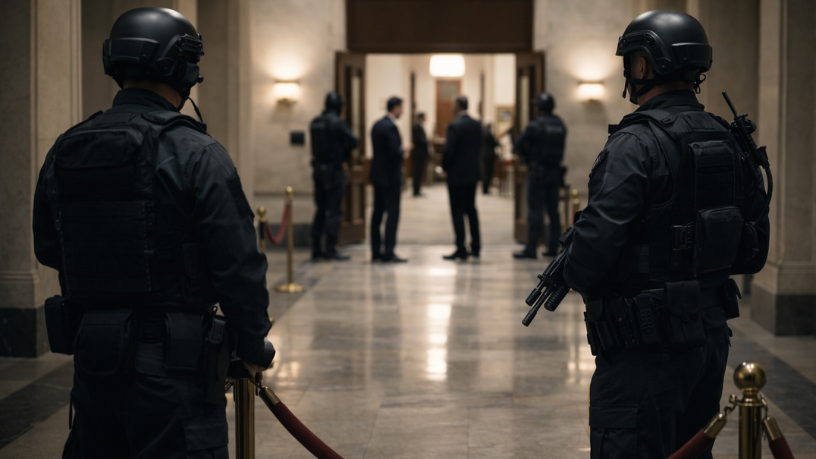
As Ernesto Kenji Igarashi explains, organizing the chain of command contributes directly to this process. When decisions follow the defined hierarchical flow, the team avoids conflicts in guidance and maintains strategic alignment throughout the entire agenda.
Why is continuous observation of the environment part of protection?
Even after the agenda begins, the team’s work remains focused on reading the scenario. Ernesto Kenji Igarashi notes that institutional environments may undergo gradual changes that, if ignored, can create vulnerabilities during the operation. During the mission, agents monitor movements in the surroundings, assess the behavior of nearby individuals, and observe logistical changes.
At the same time, this information must circulate among team members to guide positioning decisions. Thus, continuous observation becomes a preventive security mechanism. As a result, institutional security maintains progressive control of the environment. This constant attention allows the team’s actions to be adjusted proportionally.
How does training strengthen the team’s response capacity?
The technical preparation of professionals is a decisive factor in the success of the mission. Continuous training allows agents to develop greater clarity in interpreting the environment and making decisions under pressure. Operational simulations help consolidate action protocols and improve communication among team members.
These activities allow professionals to practice coordinated responses to different types of scenarios. Over time, this technical preparation becomes operational confidence. Consequently, the team is able to act with greater precision during the agenda. At the same time, constant training strengthens professional maturity and collective trust.
Operation review and the evolution of institutional security
After the agenda is concluded, the operation must be analyzed critically and in a structured manner. Ernesto Kenji Igarashi acknowledges that reviewing the decisions taken and evaluating the team’s performance contributes to improving future missions. This analysis includes examining the initial planning, the execution of roles, and the efficiency of internal communication.
In addition, the conclusions obtained should be incorporated into institutional protocols in order to strengthen operational learning. In this way, each mission becomes an opportunity for improvement.
Institutional security therefore evolves continuously, consolidating more efficient methods of operation. Operational discipline, strategic planning, constant observation, and technical training form solid foundations for the protection of authorities.
Author: Diego Rodríguez Velázquez