


Every city that grows in a disorderly way ends up paying a high price in the future. Elmar Juan Passos Varjão Bomfim, with decades of experience in large-scale infrastructure projects, understands well the cost of delays in executing essential urban developments. In practice, this liability translates into traffic congestion that consumes productive hours, insufficient drainage systems that turn ordinary rainfall into emergencies, and supply networks unable to keep pace with territorial expansion.
In this context, it is fair to say that Brazil experienced rapid urbanization in past decades without the necessary infrastructure keeping up with that pace. The result is an accumulated deficit that puts pressure on quality of life in cities and limits the economic development potential of entire regions.
Urban Infrastructure and Competitiveness: A Direct Connection
Cities equipped with solid infrastructure naturally attract new investments. This widely documented correlation shows that companies looking to expand and establish new industrial plants, distribution centers, or operational units carefully evaluate factors such as the quality of access roads, the reliability of energy supply, the availability of sanitation systems, and the efficiency of local logistics services.
Municipalities that invest strategically in infrastructure create a more attractive business environment, retain talent, and reduce operational costs for companies that choose to establish themselves there. It is no coincidence that regions with stronger infrastructure concentrate the highest levels of private investment.
As CEO of André Guimarães Engenharia e Infraestrutura, Elmar Juan Passos Varjão Bomfim has built his career around projects capable of transforming territories and creating the conditions necessary for regional economic development.
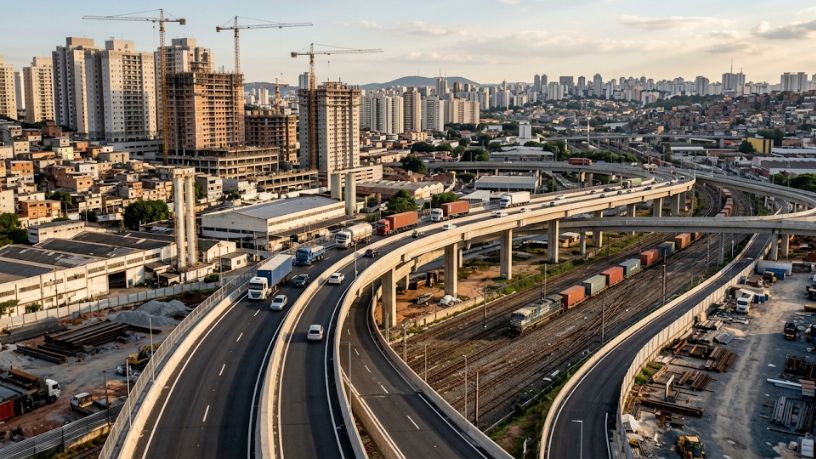
Drainage, Mobility, and Sanitation: The Invisible Pillars of Urban Development
When urban infrastructure works properly, no one notices: water drains efficiently, traffic flows smoothly, and supply systems operate without interruption. However, when something fails, society immediately recognizes how dependent it is on these structures. This paradox of invisibility is one of the biggest challenges for those advocating investments in basic infrastructure: the return is real, but often silent.
Well-designed urban drainage systems reduce flood-related losses and protect both public and private assets. Efficient mobility networks decrease commuting times and improve overall productivity. Proper sanitation lowers public healthcare costs and consistently improves social indicators.
From the perspective of Elmar Juan Passos Varjão Bomfim, whose experience includes highly complex engineering projects, works of this nature require not only engineering precision but also strong public management vision. A technically flawless execution of a poorly designed project will still produce unsatisfactory results.
The Role of Private Engineering in the Development of Public Infrastructure
Partnerships between the public sector and private engineering companies are, in many countries, the dominant model for developing urban infrastructure. In Brazil, this model has advanced in recent years, but it still faces regulatory barriers, legal uncertainty, and difficulties in structuring projects capable of sustainably attracting private capital.
Companies with proven technical expertise and experience in complex projects play a central role in this process. Elmar Juan Passos Varjão Bomfim, leading André Guimarães Engenharia e Infraestrutura, represents the type of leadership the sector needs to move in this direction: technical expertise combined with the ability to engage with the different stakeholders involved in public-interest projects.
High-quality urban infrastructure is not a cost. It is an investment with measurable returns, distributed over time and felt by every person who lives and works in the cities.
Author: Diego Rodríguez Velázquez