

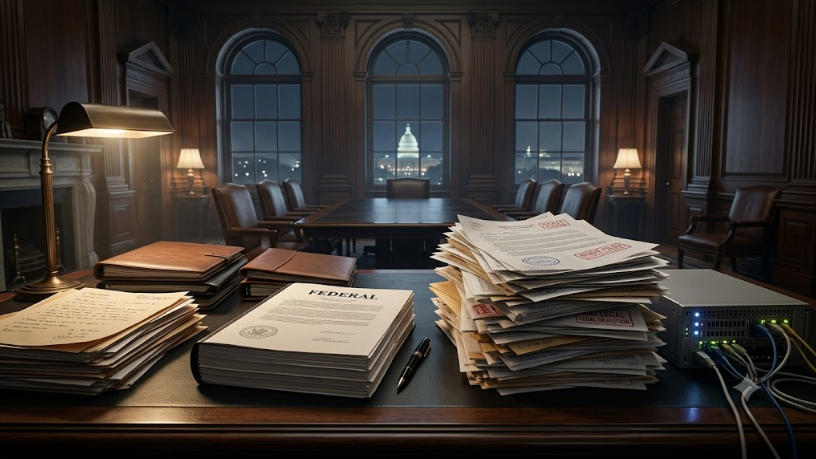
The White House and Congress are moving on their own approaches to artificial intelligence, while states like New York and California refuse to give up their existing laws
Washington has become the center of a fight that could shape how artificial intelligence works well beyond U.S. borders. The Trump administration signed a new executive order on AI security and innovation, Congress introduced its first major bill on the subject, and at the same time several states keep passing their own rules. For anyone following the tech sector from outside the country, this dispute matters, because many of the AI platforms used by businesses worldwide, from customer service tools to data analysis software, are built by American companies directly affected by these decisions. The White House, Congress and individual states disagree on how far regulation should go, and the outcome of that internal struggle is likely to reach users and companies elsewhere one way or another.
What changed with Trump’s new executive order
On June 2, 2026, President Donald Trump signed Executive Order 14409, titled “Promoting Advanced Artificial Intelligence Innovation and Security.” The order directs federal agencies to build a framework for the secure deployment of advanced AI systems, often called frontier models. According to summaries published by law firms that track tech policy, including Mintz and Lexology, the order focuses on three areas: strengthening the cyber defenses of federal information systems, creating a voluntary channel for companies that build frontier models to engage with the government before releasing new versions, and directing enforcement resources toward the criminal misuse of AI.
The order also sets thirty-day deadlines for agencies to prioritize the protection of systems considered part of national security. The Department of Homeland Security was tasked with issuing binding operational directives to speed up cybersecurity improvements and expand access to AI-enabled defensive tools for operators of critical infrastructure, including rural hospitals, community banks and local utilities. In practice, the text tries to balance two goals that do not always sit comfortably together: pushing government agencies to adopt the technology faster while shielding sensitive systems from risks created by AI itself.
The bill that could become the first major federal rule
Two days after the executive order, on June 4, Representatives Jay Obernolte, a Republican from California, and Lori Trahan, a Democrat from Massachusetts, released a 269-page discussion draft for what they call the Great American Artificial Intelligence Act, or GAAIA. Coverage from Mintz and Lexology describes it as the first comprehensive federal AI governance framework formally proposed in Congress. The draft is organized around four main pillars, and one of them stands out: it would require companies behind frontier models to disclose technical information about their systems and undergo audits carried out by newly created independent verification organizations.
That provision is particularly sensitive because it touches companies such as OpenAI, Google and Anthropic, currently at the front of advanced model development. If passed, GAAIA would impose a level of technical transparency that today is largely voluntary. The path to a vote, though, remains long. Bills of this complexity usually take months or years to move through Congress, and disagreement between Republicans and Democrats over how much regulation is actually needed is far from settled, even with Obernolte and Trahan co-authoring the initial draft together.
Why states are not giving up their own laws
Behind this whole push is an older tug of war between the federal government and individual states. On December 11, 2025, after Congress twice failed to pass a law blocking states from regulating AI on their own, Trump signed Executive Order 14365. That order calls on federal agencies to promote a national policy described as “minimally burdensome” and creates a litigation task force to challenge state AI laws considered inconsistent with federal policy, according to a review of U.S. AI legislation published by the consulting firm SIG.
State resistance, however, remains strong. Laws such as New York’s RAISE Act and California’s SB 53 are still in force and show that state governments, particularly those led by Democrats, are not backing down even under the threat of federal lawsuits, according to reporting from MIT Technology Review’s Brazilian edition. The U.S. Senate, for its part, already rejected an attempt to attach a ten-year freeze on state AI laws to a broader budget package, voting 99 to 1 against it, a result that illustrates just how much bipartisan resistance exists to a single federal rule overriding everything states have already built.
What this means for companies and users outside the United States
For readers who rely on AI tools at work or run a business that depends on these platforms, the outcome of this domestic fight in the United States tends to filter, over time, into usage policies, terms of service and transparency requirements adopted globally by major tech companies. Stricter audit and disclosure rules in the U.S. often end up shaping how these companies operate in other markets too, since many prefer to standardize internal compliance processes rather than maintain different versions for each country.
At the same time, the standoff between Washington and the states makes clear that there is no single answer today, inside the United States, on how to regulate artificial intelligence. Congress is also debating, in parallel, more specific proposals, including rules for chatbots that interact with minors and restrictions on non-consensual digital replicas and AI-generated imagery, according to TechPolicy.Press’s July roundup. That patchwork of initiatives suggests AI regulation in the United States will likely keep being built piece by piece, through court rulings, executive orders and state laws, rather than through one single federal statute meant to settle everything at once.
Sources consulted: Lexology, Mintz, Software Improvement Group, MIT Technology Review Brasil, TechPolicy.Press