

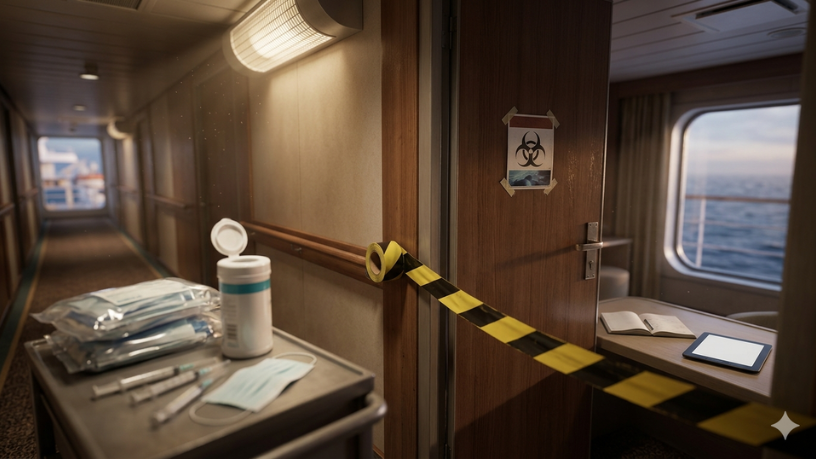
A hantavirus outbreak aboard a cruise ship in the Atlantic has placed the disease at the center of the global debate on epidemiological surveillance in confined environments. In this article, we examine what this episode reveals about the behavior of the Andes virus, the possibility of human-to-human transmission, the challenges of clinical management with no specific treatment available, and what health authorities need to consider when facing outbreaks in contexts of high international mobility.
An Unprecedented Outbreak at Sea
The MV Hondius, a Dutch-flagged vessel, became the stage for the first documented hantavirus outbreak on a maritime cruise ship. Carrying approximately 150 passengers, the ship was forced to remain adrift in the Atlantic Ocean while awaiting the medical evacuation of infected crew members. By early May 2026, the toll included three deaths, two laboratory-confirmed cases, and five suspected cases, in addition to other individuals reporting milder symptoms.
The clinical picture described by health authorities is characteristic of the severe forms of the disease: fever, gastrointestinal symptoms, rapid progression to pneumonia, acute respiratory distress syndrome, and shock. This is a presentation that leaves no room for diagnostic complacency, especially given that no specific approved treatment exists for the infection. Management is entirely supportive, with mechanical ventilation required in the most critical cases.
The Central Question: Person-to-Person Transmission
The aspect that sets this outbreak apart from previous episodes, and that warrants careful analytical attention, is the suspicion of human-to-human transmission. The World Health Organization indicated that this mode of contagion cannot be ruled out, given that some of the confirmed cases had very close contact with one another, including couples sharing cabins.
This detail is significant because most hantavirus variants do not spread from person to person. Infection typically occurs through contact with infected rodents or their secretions, such as urine, feces, and saliva. However, the Andes virus, found primarily in Chile and Argentina, the countries of origin along the cruise route, is the only known variant with documented capacity for human-to-human transmission, albeit limited and associated with extremely close contact.
The WHO indicated that its working hypothesis is precisely that this is the Andes variant, pending confirmation through genetic sequencing being conducted in South Africa. If confirmed, this hypothesis will have direct implications for the isolation protocols adopted on board and for the approach taken with suspected cases in the passengers’ destination countries.
The Analytical Challenge of Epidemiology in Confined Spaces
Beyond the virological dimension, this outbreak raises a question that deserves broader reflection: how should health surveillance systems respond when a rare and severe pathogen emerges within a closed, internationally mobile environment such as a cruise ship?
Cruise vessels concentrate people from multiple countries in a space where ventilation, shared common areas, and close cohabitation create conditions that amplify transmission risks for any respiratory pathogen. In the case of the Andes virus, where even limited human-to-human transmission is possible, this scenario becomes particularly sensitive. The speed with which the WHO was notified, by the United Kingdom as the flag state’s regulatory jurisdiction, and the coordination with South Africa for laboratory testing reflect the kind of international architecture that such situations demand.
Even so, health authorities have been careful to emphasize that the outbreak does not represent a wider public health risk. The risk to the general population remains low, and any suspected human-to-human transmission appears to be restricted to contexts of prolonged and intimate contact. This distinction is crucial to prevent unnecessary alarm while maintaining vigilance proportional to the actual epidemiological threat.
What This Episode Signals for Global Health Preparedness
From a public health perspective, the MV Hondius case is a practical stress test for outbreak response systems under atypical conditions. Hantavirus is not a new pathogen, but its emergence in a cruise ship setting, with passengers from various nationalities disembarking in different ports, demands a level of coordination that goes far beyond local containment measures.
The absence of specific antiviral treatment makes early clinical recognition even more critical. Supportive care, including mechanical ventilation and intensive monitoring, can be decisive in reducing mortality, but it requires infrastructure that is simply not available on board a ship. Medical evacuation, as occurred in this case, becomes both a clinical and logistical necessity.
The Andes virus has long been studied in the context of South American outbreaks in rural and isolated communities. Seeing it surface in a luxury cruise ship crossing the Atlantic forces a reassessment of transmission scenarios that epidemiological models have rarely contemplated. This alone justifies sustained scientific attention, not out of alarm, but out of the understanding that preparedness is always built before the emergency, never during it.
Autor: Diego Velázquez