

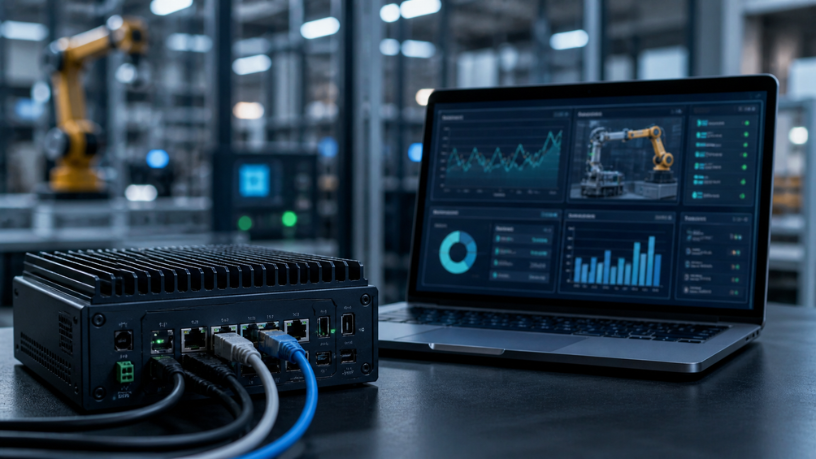
According to Luciano Colicchio Fernandes, the expansion of the Internet of Things is pushing companies to rethink their technological architectures. The exponential growth of connected devices demands faster, more secure, and more efficient ways of processing data. This article analyzes how edge computing has become a key element in this scenario, addressing its benefits, challenges, and practical applications.
Throughout the content, it becomes clear why the traditional cloud-only model is no longer sufficient for current demands. The discussion also explores the competitive advantages of decentralized processing and how companies can strategically adopt this approach to ensure operational efficiency.
What is edge computing and what is its role in IoT?
Edge computing refers to processing data closer to its source, such as sensors and connected devices. Instead of sending all information to central servers, part of the processing happens locally, reducing response time and dependence on external networks.
This model becomes essential in the IoT context, where millions of devices continuously generate data. Luciano Colicchio Fernandes highlights that this decentralization enables faster and more efficient decision-making, especially in environments that require real-time responses.
Why is traditional cloud computing not enough?
Although cloud computing has revolutionized technology, it presents limitations when applied to high-demand and low-latency scenarios. Constant data transmission to distant servers increases response time and can compromise the efficiency of critical systems.
In addition, network congestion and the costs associated with transmitting large volumes of data make the centralized model less viable. Luciano Colicchio Fernandes notes that exclusive reliance on the cloud can create operational bottlenecks and reduce companies’ competitiveness.
What are the main benefits of edge computing?
One of the main benefits of edge computing is reduced latency. By processing data locally, systems can respond almost instantly, which is essential for applications such as industrial automation and smart cities.
Another important advantage is resource efficiency. By filtering and processing data at the source, only relevant information is sent to the cloud, reducing costs and improving infrastructure efficiency.
How does this technology impact business performance?
Adopting edge computing allows companies to operate with greater autonomy and resilience. Even during connection instability, systems continue to function, ensuring operational continuity and avoiding losses.
Real-time analysis enables faster and more strategic decision-making. This agility increases productivity and improves companies’ ability to adapt in highly competitive markets.
What challenges must be considered?
Despite its advantages, implementing edge computing is not a simple task. Distributed processing requires a more complex infrastructure, as well as efficient monitoring and management tools.
Another important challenge is security. Edge devices can become vulnerable points if not properly protected. Luciano Colicchio Fernandes emphasizes that robust cybersecurity policies are essential to ensure data integrity.
Is edge computing the future of IoT?
The trend points toward the integration of edge computing and cloud computing, creating more efficient hybrid models. This combination balances performance, scalability, and security by leveraging the strengths of both approaches.
Companies that adopt this strategy will be better prepared to handle IoT growth. Luciano Colicchio Fernandes concludes that edge computing is no longer an optional innovation but an essential component to sustain digital transformation.
Author: Diego Rodríguez Velázquez