

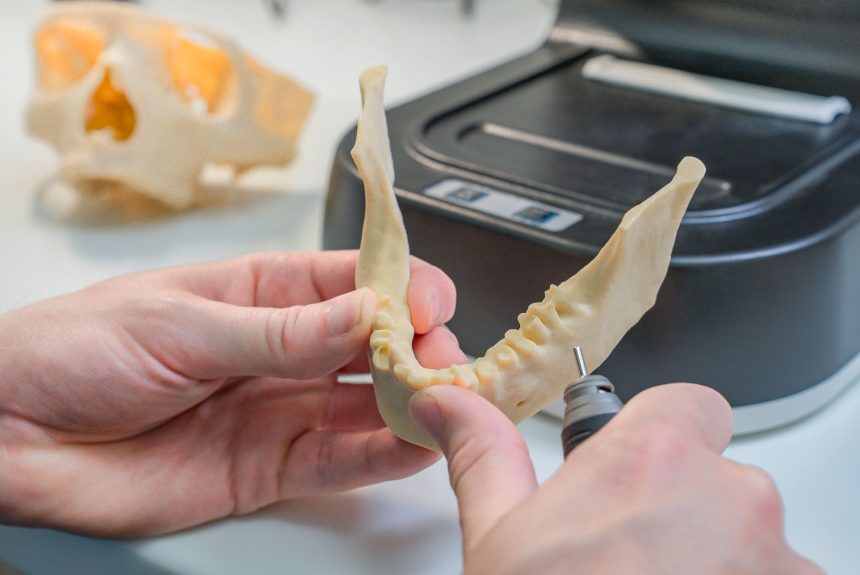
Brazil’s Ministry of Health is expanding the use of digital technology to produce dentures through the Unified Health System, known as SUS. Practical workshops are being held in municipalities across every region of the country to train dental professionals and support the implementation of a digital workflow for public dental laboratories.
The initiative focuses on the use of intraoral scanners, planning software, 3D printers and equipment for washing and post-curing printed components. According to the Brazilian Ministry of Health, the goal is to incorporate these tools into Regional Dental Prosthesis Laboratories and increase production capacity, speed and standardization in publicly provided oral healthcare.
How the digital denture workflow works
The process begins with the capture of a patient’s oral structures using an intraoral scanner. The device generates a three-dimensional model that can be analyzed and adjusted in specialized planning software. Once the digital design is completed, the denture is produced with a 3D printer before moving through additional laboratory and clinical stages.
The workflow also includes washing, post-curing, finishing, characterization, adjustments and clinical installation. By organizing these steps digitally, the public system is introducing a production method designed to reduce manual stages and improve consistency. The Ministry of Health describes the technology as a way to support precision and standardization while expanding the capacity of services that already provide dentures through the SUS.
Equipment has reached more than 300 municipalities
The Ministry of Health reported that 316 municipalities had already received the equipment by September 28, 2026. The broader plan calls for 500 equipment kits to be delivered to 409 municipalities. Some cities will receive more than one kit, depending on population size and local demand for dental services.
The national distribution gives the program a broad geographic scope, covering municipalities in all regions of Brazil rather than concentrating the technology in a single state or metropolitan area. The equipment is intended for use by Regional Dental Prosthesis Laboratories, which are part of the public network responsible for supporting denture production and oral health services.
Training combines online classes and practical workshops
Professional training is being organized in two stages. The first is a virtual theoretical phase, followed by in-person practical workshops. Professors from the Federal University of Uberlândia are leading the hands-on training as part of the university’s partnership with the project.
The target audience includes dentists and dental prosthesis technicians who will operate the equipment and integrate the digital workflow into public services. The training is therefore focused not only on delivering machines, but also on preparing the professionals responsible for scanning, digital planning, printing and completing the prostheses.
Digital procedures receive regulatory support
The expansion follows measures adopted earlier in 2026. In July, Brazil’s Tripartite Interagency Commission agreed to incorporate intraoral scanners, 3D printers and planning software into SUS dental laboratories. At the time, the Ministry of Health said the public system produced approximately 1.2 million dentures annually and that laboratories adopting the digital workflow could receive a 30% increase in monthly funding.
The policy framework was also reinforced by Ordinance GM/MS No. 11,397, dated May 25, 2026. The regulation added dental procedures performed through a digital workflow to the SUS procedure table. The official text, available through the Virtual Health Library of Brazil’s Ministry of Health, links the technology to greater precision, process standardization and fewer clinical and laboratory stages.
The July agreement was detailed in another Ministry of Health announcement about digital dentures and the national oral health network. Together, the measures show that Brazil’s adoption of digital denture production is being implemented through equipment distribution, professional training and changes to the public healthcare system’s administrative and reimbursement structure.