

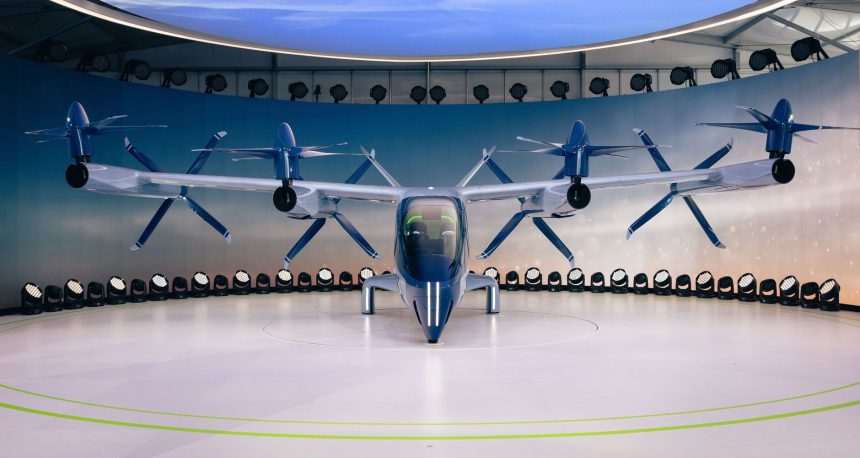
Brazil is taking steps to prepare for the possible arrival of electric aircraft capable of vertical takeoff and landing, known as eVTOLs. The effort involves government authorities, aviation regulators, airspace management officials and Eve Air Mobility, a company developing this type of aircraft.
A meeting held on September 21, 2026, brought together representatives of Brazil’s Ministry of Ports and Airports, the National Civil Aviation Secretariat, the National Civil Aviation Agency, known as ANAC, the Department of Airspace Control, or DECEA, and Eve Air Mobility. The meeting was disclosed by the Brazilian Ministry of Ports and Airports on September 22.
The discussions focused on issues that must be addressed before eVTOLs can operate commercially in Brazil. Among them are aircraft certification, the creation of suitable infrastructure, the organization of airspace and the definition of operational rules. The topics show that the introduction of the aircraft will depend on a coordinated regulatory and technical process rather than on the availability of a vehicle alone.
Certification remains a central step
One of the main regulatory challenges is adapting aviation requirements to an aircraft configuration that differs from conventional airplanes and helicopters. In July 2026, ANAC opened sector consultations on airworthiness and noise certification criteria for Eve’s EVE-100 eVTOL project.
According to ANAC, existing requirements were not directly applicable to the characteristics of the new aircraft. The consultations, opened on July 21, were intended to gather contributions on the criteria that may be used to evaluate the EVE-100’s airworthiness and noise performance.
Certification is a prerequisite for any future commercial operation. It involves demonstrating that the aircraft meets technical and safety requirements established by the competent aviation authority. The consultation process does not represent an approval for passenger service, nor does it mean that the EVE-100 is already operating in Brazil.
Infrastructure and airspace planning
The preparation also includes the locations where eVTOL aircraft could take off and land. These facilities are often referred to as vertiports, although the official documents cited in the discussion focus more broadly on infrastructure for eVTOL operations. Their design and operation must be considered alongside safety procedures, access requirements and integration with existing aviation facilities.
ANAC has previously issued guidance for airport and aerodrome operators concerning infrastructure for eVTOL takeoffs and landings. The agency’s 2023 alert on eVTOL infrastructure provides regulatory context for operators preparing for the characteristics of this emerging category of aircraft.
Airspace organization is another part of the planning. DECEA’s participation in the September meeting reflects the need to evaluate how future eVTOL flights would be coordinated within Brazil’s air traffic management system. The process will require rules that define how the aircraft interact with existing aviation operations and controlled airspace.
Potential São Paulo connection
During the meeting, Eve presented a possible route between São Paulo’s South Zone and São Paulo/Guarulhos International Airport. The company estimated that the journey could take approximately 12 minutes using an eVTOL aircraft.
The figure is a projection presented by Eve and should not be interpreted as an existing commercial service. The route was cited as an example of how the technology could be used to connect urban areas with airports in a country where road congestion can make ground transportation time-consuming. Any future operation would still depend on certification, infrastructure, airspace coordination and applicable operating rules.
For Brazil, the discussion has significance beyond a single company or proposed route. The participation of the Ministry of Ports and Airports, the National Civil Aviation Secretariat, ANAC and DECEA indicates that the country is examining the institutional requirements for a new form of air mobility. It also places regulation and safety at the center of the debate as manufacturers seek to develop electric aircraft for urban and regional transportation.
What happens next
The next stages will involve the analysis of regulatory contributions, the development of certification criteria and continued planning for infrastructure and operations. These steps are necessary to establish how eVTOL aircraft could be evaluated, where they could operate and how their flights would be integrated into Brazil’s aviation system.
For now, Brazil is in a preparation phase. The September meeting and ANAC’s consultations indicate that public authorities are working to define the conditions for future eVTOL operations, but they do not establish a launch date for commercial flights. The technology’s presence in the Brazilian market will depend on the completion of the regulatory and operational requirements under development.