
Trade tensions, inflation, interest rates and technology investments are reshaping the U.S. business environment, with consequences for Brazil.
The U.S. business environment has gained new sources of pressure in recent days, with effects extending beyond Wall Street and reaching Brazilian companies that depend on the American market. The current scenario combines trade tariffs, persistent inflation, expectations surrounding Federal Reserve interest rates and strategic changes by major companies facing growing technological competition. For businesses operating in or connected to the United States, the main question is whether these pressures represent temporary turbulence or a more lasting transformation in international trade and corporate costs.
The latest figures show that the U.S. economy continues to handle enormous volumes of international trade. In July, however, the U.S. trade deficit in goods and services increased to $88.6 billion, while imports of capital goods reached a record $140.3 billion. At the same time, Brazil is facing a more challenging trade environment following new U.S. tariffs on certain Brazilian products. These developments make the American market particularly important for Brazilian exporters, investors and companies seeking opportunities in the United States.
U.S. Tariffs Are Changing the Business Calculations for Brazilian Companies
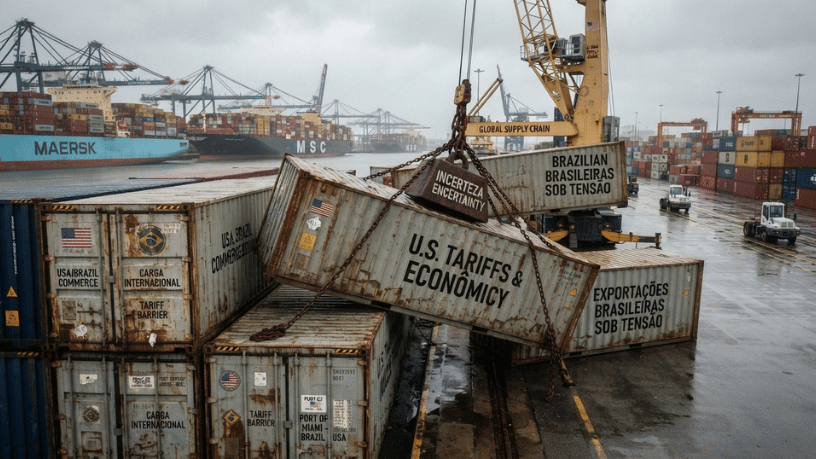
Washington’s trade policy has become one of the main concerns for Brazilian companies selling products in the United States. In July, the U.S. Trade Representative announced a 25% tariff on certain Brazilian products, citing what the U.S. government described as issues affecting American commercial interests. The decision followed an investigation that lasted approximately one year and examined areas including digital trade, payment services, ethanol, intellectual property and deforestation.
The impact on Brazil, however, cannot be measured simply by looking at the existence of a tariff. Exporting companies must determine whether they can pass the additional cost on to American buyers, accept lower profit margins, change suppliers or seek alternative markets. Brazilian government data showed that exports to the United States totaled approximately $3.19 billion in August, an increase of 12.1% from the same month a year earlier, although the increase was strongly influenced by higher average prices. This means that nominal growth in export revenue does not necessarily represent a proportional increase in the volume of goods sold.
For American companies, the situation also creates additional costs. Tariffs on imported products can increase the price of raw materials, components and merchandise used by manufacturers and distributors in the United States. Some companies may respond by replacing foreign suppliers with domestic producers, but that transition generally requires time, investment and sufficient industrial capacity. The result could be a restructuring of supply chains, particularly in sectors where Brazil and the United States have established commercial relationships.
The issue is therefore broader than the price of individual products. A tariff can influence purchasing decisions, production strategies, transportation costs and corporate investment plans. For Brazilian exporters, maintaining access to the American market may require greater efficiency and diversification. For U.S. companies, meanwhile, the challenge is to balance domestic production goals with the cost and availability of international suppliers.
U.S. Economy Keeps Interest Rates and Costs at the Center of Business Decisions
Another major factor affecting American businesses is the combination of inflation, oil prices and monetary policy. On September 8, the S&P 500 fell 0.58%, while the Dow Jones declined 1.18% and the Nasdaq lost 0.32%, as investors reacted to higher oil prices and expectations surrounding upcoming inflation data. Brent crude moved close to $100 a barrel, increasing concerns about higher costs for companies and consumers.
Financial markets are also closely watching the Federal Reserve meeting scheduled for September 15 and 16. According to market expectations reported by Reuters, traders were assigning a significant probability to an interest-rate increase, although new inflation indicators could still change those expectations. For businesses, higher interest rates can make borrowing more expensive, while American households may reduce spending in sectors that depend heavily on consumer credit.
The labor market provides another important measure of the strength of the U.S. economy. The Bureau of Labor Statistics reported that U.S. employers added 162,000 jobs in August and that the unemployment rate remained at 4.1%. In July, the country had approximately 7.3 million job openings, a relatively stable level. For businesses, this points to an economy that still has considerable demand and hiring activity, although wages, financing expenses and operating costs remain important factors in corporate planning.
This combination creates a complicated environment for companies. A strong labor market can support consumer spending, but persistent inflation can limit purchasing power. Higher energy prices can raise transportation and production expenses, while elevated interest rates can make expansion and investment more expensive. Businesses therefore need to make decisions while facing several economic variables at the same time.
What Brazilian Companies Should Watch in the U.S. Market
The American business environment must also be viewed through the size of the economic relationship between Brazil and the United States. U.S. Census Bureau data show that from January through July 2026, the United States exported approximately $32 billion in goods to Brazil and imported about $20.47 billion from the country, leaving an American goods trade surplus of roughly $11.53 billion. These figures help explain why decisions made in Washington can affect both Brazilian exporters and American companies that depend on suppliers, customers and commercial partners in Brazil.
For a Brazilian company, monitoring the U.S. market therefore means more than simply following the exchange rate. Businesses must also track tariffs, import regulations, transportation expenses, American interest rates and strategic decisions by major corporations that could reshape global supply chains. Washington’s trade policy indicates a preference for strengthening domestic production and encouraging trading partners to change certain practices. That could create opportunities for companies capable of expanding production or operations inside the United States.
A second major development is the technological transformation of American businesses. The race to develop artificial intelligence is redirecting corporate investment, while software companies face new questions about how advanced AI systems could affect their existing business models. In U.S. financial markets, some software stocks have recently faced pressure, while semiconductor manufacturers and companies involved in AI infrastructure have attracted strong investor attention.
For Brazilian companies, this technological shift could create opportunities in areas such as software, cloud services, artificial intelligence, data infrastructure and specialized business services. At the same time, it could increase competition from American and Asian technology companies. Brazilian businesses seeking to enter the U.S. market will increasingly need to consider not only price and exchange rates, but also technological capability, productivity and the ability to scale.
The central issue for Brazilian readers is that the U.S. business environment is being shaped by several forces at once. The economy continues to show a relatively resilient labor market and substantial investment activity, but tariffs, energy prices, inflation and interest rates are making corporate planning more difficult. For companies that export to the United States, import American products or conduct transactions in dollars, these variables can directly influence prices, profit margins and investment decisions.
The coming weeks will be particularly important as new inflation data and Federal Reserve decisions provide clearer signals about the cost of money in the United States. On the trade side, the evolution of tariffs and Brazilian exports to the American market will help determine whether companies can absorb the additional costs without losing competitiveness. For Brazilian businesses, following the United States has become increasingly important because changes there can reach Brazil through three major channels: trade, exchange rates and prices. Understanding these connections can help companies anticipate risks while identifying new opportunities in one of the world’s largest markets.
Sources:
- U.S. Trade Representative — Section 301 Action on Brazil (United States Trade Representative)
- U.S. Census Bureau — U.S. Trade in Goods with Brazil (Census.gov)
- U.S. Census Bureau — U.S. International Trade, July 2026 (Census.gov)
- Federal Reserve — 2026 FOMC Meeting Calendar (Reserva Federal)
- Federal Reserve — July 2026 FOMC Statement (Reserva Federal)
- U.S. Census Bureau — Top Trading Partners, July 2026 (Census.gov)