
The U.S.-China AI rivalry is expanding beyond software, with potential consequences for chips, investments, companies and technology costs in Brazil.
Artificial intelligence has entered a new stage of the technological rivalry between the United States and China. In recent days, U.S. officials accused Chinese companies, including DeepSeek, Moonshot AI and Alibaba, of using “distillation” techniques to take advantage of results produced by advanced U.S. AI models and accelerate the development of their own systems. The accusations, reported on September 8, intensify pressure in a rivalry that already involves chips, infrastructure, intellectual property and national security.
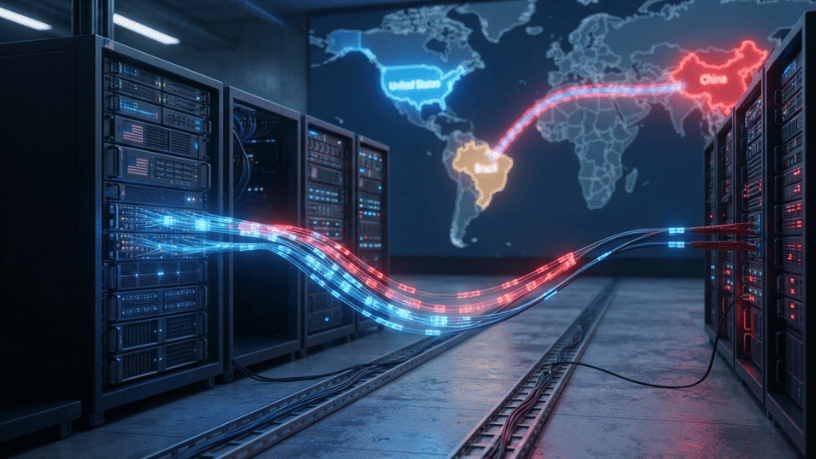
For Brazilian readers, the issue goes far beyond a dispute between Washington and Beijing. The competition could influence the availability of advanced chips, the cost of artificial intelligence services, technology investments and the strategies of Brazilian companies that depend on cloud computing. The developments also come as the U.S. government seeks to preserve American leadership in technologies considered strategically important.
Why the U.S. is accusing Chinese companies of copying artificial intelligence technology
According to U.S. officials cited by Reuters, six Chinese companies allegedly used versions of models developed by American companies to train their own systems through a process known as distillation. In simple terms, the technique allows a smaller model to learn to reproduce certain behaviors and capabilities by observing responses generated by a more advanced system. The technology can be used legitimately in AI research, but Washington argues that, in the cases it identified, it was allegedly employed on a large scale and potentially with the knowledge of the Chinese government.
The accusations involve major Chinese technology companies such as DeepSeek, Moonshot AI and Alibaba, while also reinforcing a broader American concern that has already shaped semiconductor export controls. The U.S. Commerce Department says its export restrictions are intended to limit China’s access to advanced technologies that could have both commercial and military applications. Government documents identify advanced computing chips and semiconductor-manufacturing equipment as strategic components of the broader technological competition.
The central issue is that the AI race is no longer simply a competition between popular chatbots. Advanced models require enormous amounts of computing power, data centers, specialized semiconductors, electricity and capital. As a result, controlling access to sophisticated chips has become an instrument of economic policy and national security. U.S. technology policy increasingly links artificial intelligence, semiconductors and industrial competitiveness as essential elements of maintaining American leadership.
China’s response is also important for understanding the situation. Beijing has rejected the accusations and argued that the development of Chinese artificial intelligence is based on domestic scientific progress, while also calling for greater cooperation between the two countries. The tension comes at a sensitive moment, as Washington and Beijing are expected to continue discussions about AI risks and prepare for high-level diplomatic meetings.
How the U.S.-China technology dispute could affect Brazilian companies and consumers
For Brazil, one of the most important potential effects involves the infrastructure required to develop and operate artificial intelligence. Brazilian companies using cloud services, generative AI models, data-analysis platforms or automated systems depend, directly or indirectly, on computing capacity provided by major international technology companies. If the U.S.-China dispute leads to tighter restrictions on chips and components, the costs of expanding that infrastructure could be affected. This does not necessarily mean an immediate increase for Brazilian consumers, but it creates another variable for companies planning investments in AI.
The dispute could also influence the technology market itself. The American effort to maintain leadership is encouraging investments in chips, data centers and new AI applications, while Chinese companies are seeking alternatives that reduce their dependence on U.S. components. This week, Qualcomm announced a partnership with Amazon to develop multiple generations of customized AI chips for data centers, illustrating how computing infrastructure is becoming a strategic area for major American companies.
For Brazilian businesses, this environment creates both opportunities and risks. On one hand, expanding U.S. infrastructure could increase the global supply of AI tools and encourage cheaper and more specialized solutions. On the other hand, new trade restrictions could make certain chips and technologies harder to move across international markets, particularly when suppliers, data centers and customers operate in different countries. Brazil, which is seeking to expand innovation and digitalization, therefore needs to monitor these changes because its position in the global technology chain depends partly on access to competitive infrastructure.
Investment is another important factor. The U.S. government says its current technology strategy aims to establish the country as the world’s leading AI power, while the White House has emphasized public and private investment in technology, energy and infrastructure. A G20 innovation ministerial meeting held in North Carolina in early September also addressed pro-innovation policies, workforce development, intellectual property related to AI, technology standards and supply chains.
What happens next with AI in the U.S. and why Brazil needs to pay attention
The next stage of the competition will likely be determined less by which company has the most popular chatbot and more by which country can build the infrastructure needed to bring artificial intelligence into the broader economy. A recent Goldman Sachs report cited this week highlighted this shift in focus, pointing to sectors such as industry, energy, logistics, defense and manufacturing as potential drivers of the next wave of AI investment. This means the technology is increasingly moving beyond digital applications and into industrial operations and specialized services.
In the United States, that transformation is already generating domestic debate. The expansion of data centers needed to support AI has faced opposition in some American communities because of concerns over electricity consumption, water use and pressure on local infrastructure. At the same time, technology companies and government officials argue that expanding this capacity is essential to maintaining U.S. leadership over China. The debate demonstrates that AI policy in America is no longer limited to Silicon Valley: it increasingly involves energy, jobs, investment, national security and politics.
Another sign of AI’s growing strategic importance is the position taken by American technology companies regarding export controls. Anthropic recently left the Information Technology Industry Council after disagreements involving proposals that could expand controls over exports of American chips to countries considered strategic competitors. Among the proposals is the AI OVERWATCH Act, which would give Congress a greater role in reviewing certain licenses for dual-use chips. The U.S. Senate is scheduled to return on September 14, when national defense legislation is expected to become an important part of the political agenda.
For Brazil, following this process will be increasingly important because U.S. technology policy can generate effects far beyond American borders. Changes in export rules can alter suppliers and costs; new generations of chips can accelerate AI applications; and a sharper confrontation with China could reorganize global technology supply chains. Brazilian companies, policymakers and consumers therefore have an interest in understanding these decisions before their effects become visible in the domestic market.
The U.S.-China competition over artificial intelligence is consequently becoming a major economic and geopolitical issue with international consequences. The accusations against Chinese companies represent another chapter in a rivalry involving intellectual property, semiconductors, data centers and national security. For Brazilians, the key point is that decisions made in Washington and Beijing can eventually influence technology prices, digital services, investment and access to advanced computing. Over the coming months, new U.S. rules involving AI and semiconductors will help determine whether the rivalry develops through negotiations or increasingly restrictive controls.
Fontes: