
Washington’s new diplomatic offensive involves security, trade and strategic minerals and could reshape the relationship between the United States and Brazil.
The United States government has intensified its political engagement in Latin America this week, once again placing the region at the center of Washington’s foreign policy strategy. U.S. Secretary of State Marco Rubio began a trip to Colombia, Ecuador and Peru, focusing on security, the fight against drug trafficking, migration, trade and strategic minerals. The move comes as the U.S. seeks closer ties with Latin American governments aligned with Donald Trump’s priorities and attempts to expand American influence across the continent.
For Brazil, the issue deserves attention because changes in U.S. policy could affect trade, investment, commodity prices, diplomatic relations and even the competition for influence with China. Although the Brazilian government is not among the main destinations of Rubio’s current trip, Brazil remains one of the region’s largest economies and an important U.S. trading partner. The central question for Brazilian readers, therefore, is to understand what Washington is trying to build in Latin America and how this could affect Brazil in the coming months.
Why the United States is strengthening its presence in Latin America
Marco Rubio’s trip represents an attempt to turn U.S. policy toward Latin America into a more strategic agenda, combining security, economic interests and political alignment. In Colombia, the U.S. secretary announced expanded cooperation with the new government of Abelardo De La Espriella, including initiatives related to combating drug trafficking, intelligence and security equipment. Rubio also signaled interest in accelerating trade agreements with Colombia, Ecuador and Peru, showing that Washington intends to use economic relations as part of its foreign policy.
The move is also connected to competition between the United States and other major powers in the region, particularly China. Washington is seeking to increase its participation in strategic sectors such as energy, infrastructure, critical minerals and technology, while Latin American governments attempt to maintain diversified trade relations. For the U.S., strengthening alliances across the continent could reduce opportunities for external competitors and increase American influence over economic and political decisions. Peru, for example, was incorporated into the so-called “Shield of the Americas,” an initiative promoted by the Trump administration to deepen regional cooperation on issues such as transnational crime and security.
The American strategy is also unfolding amid closer ties between Washington and conservative governments in Latin America. Rubio has openly supported Colombia’s new president and has promoted a regional agenda based on combating drug trafficking, controlling migration and greater alignment with U.S. interests. This repositioning could have indirect effects on countries that adopt a different approach, such as Brazil, particularly on issues involving Venezuela, trade, regional security and relations with China.
For Brazilians, this means that U.S. foreign policy is no longer a distant subject. Decisions made in Washington can influence commodity markets, foreign investment, trade flows and the behavior of the dollar. Because Brazil’s economy is deeply integrated into international trade, changes in the U.S. strategy toward its neighbors could alter opportunities for Brazilian companies and affect competition in sectors such as oil, mining, agribusiness and technology.
What the new U.S. strategy could change for Brazil
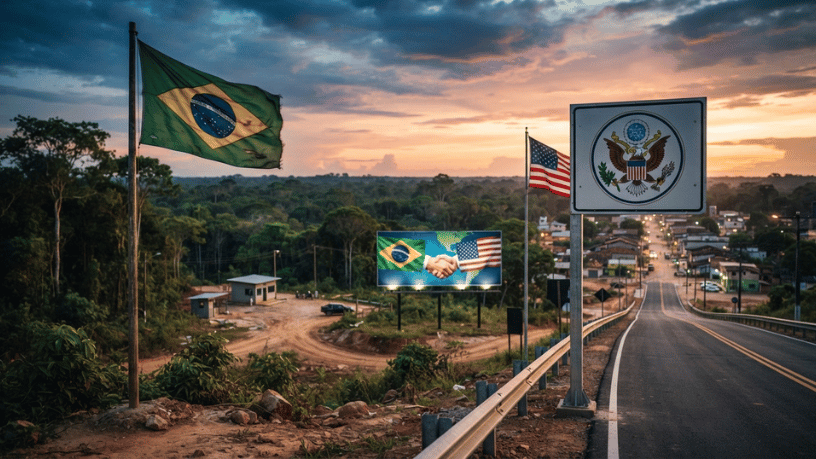
Brazil occupies a different position from the countries visited by Rubio, but that does not mean it is outside Washington’s radar. At the beginning of September, Donald Trump said he maintained a “good relationship” with Brazil and highlighted political changes in South America. At the same time, relations between Washington and Brasília remain marked by commercial and diplomatic issues that require close monitoring, especially because U.S. tariff decisions can directly affect Brazilian exporters.
One of the main potential effects is trade. When the United States expands agreements and benefits for certain Latin American partners, companies from those countries may gain competitive advantages over Brazilian competitors. This could be relevant for sectors competing in the U.S. market, while closer ties between Washington and regional governments could also create opportunities for integrated supply chains. The final impact will depend on tariffs, rules of origin and the trade agreements negotiated individually.
Another important issue is competition for strategic minerals and energy. Colombia, Ecuador and Peru have significant natural resources, while Brazil also has major mineral reserves and an important position in the energy market. The U.S. search for closer suppliers could benefit Latin American countries capable of providing critical minerals, oil, gas or agricultural products under competitive conditions. For Brazil, this represents both an opportunity to negotiate with Washington and a challenge as it competes for investment.
There is also a currency-related effect that directly matters to Brazilian consumers. Geopolitical tensions, changes in trade relations and shifts in risk perception can cause movements in financial markets and influence the dollar. A stronger U.S. currency tends to make imported products, international travel and certain services more expensive, while Brazilian exporters may receive more reais for revenues earned in dollars. As a result, U.S. foreign policy can reach everyday life in Brazil through prices and exchange rates.
What Brazilians should watch in the coming months
The next step will be to observe whether the current U.S. diplomatic offensive remains concentrated on countries politically aligned with Washington or expands to other governments in the region. Rubio’s visits to Colombia, Ecuador and Peru demonstrate a clear priority for security and economic cooperation, but Brazil’s size makes it inevitable that Washington’s decisions will also take its relationship with Brasília into account. The question will be whether the Brazilian government can turn its economic weight into greater negotiating power.
It will also be important to monitor the evolution of U.S. trade relations with Latin American countries. If Washington offers more favorable conditions to certain partners, Brazilian industries could face increased competition in the American market. On the other hand, Brazilian companies could find new opportunities if the U.S. seeks to diversify suppliers and reduce external dependencies in strategic areas.
The geopolitical dimension deserves similar attention. The expansion of American engagement on the continent is taking place while China maintains a strong commercial presence in Latin America, particularly in infrastructure, energy and mining. Brazil has deep economic ties with Beijing while also maintaining the United States as an important trading partner, placing Brasília in a delicate diplomatic equation. The country may seek to preserve its autonomy and diversify its partners without allowing competition between Washington and Beijing to become a forced choice.
For those following the Brazilian economy, the most important indicators will be foreign trade, the dollar’s performance, investment flows and commodity prices. For those following international politics, attention should focus on Washington’s next decisions concerning Latin America, migration, security and trade agreements. Marco Rubio’s movements show that the United States is once again treating the continent as a priority area of its foreign policy, and this is likely to have consequences for Brazil as well. In the coming months, Brazil’s ability to negotiate with Washington while simultaneously preserving its relationships with other partners will be one of the central issues in the country’s foreign policy.
Sources: Associated Press — coverage of Marco Rubio’s Latin America trip · Reuters — U.S. cooperation with Colombia and trade agreements · White House — recent actions by the Trump administration · UOL — Shield of the Americas and closer U.S. ties with Peru