

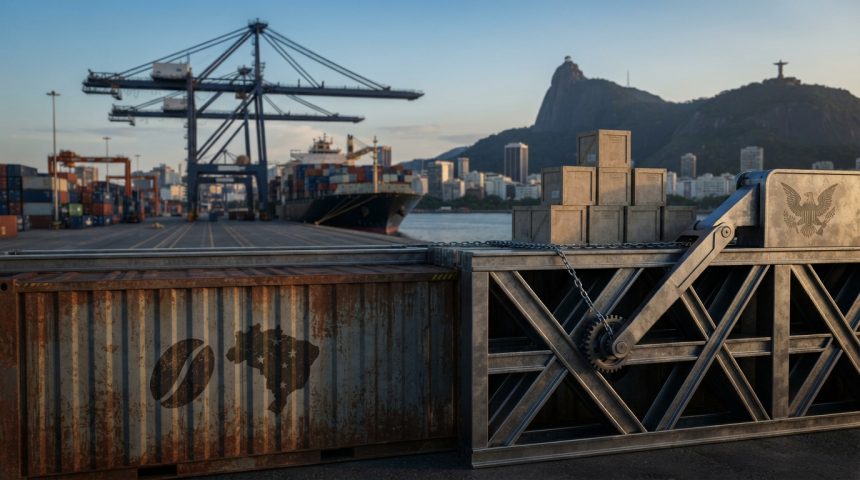
New US trade measures raise concerns over Brazilian exports, the dollar, prices, and the future of economic relations between Washington and Brasília.
US trade policy returned to the center of international attention this week, as new White House decisions and growing tensions reinforced the use of tariffs as a tool of economic and foreign policy. While Washington increases pressure on trading partners and industries considered strategically important, Brazil is closely watching the potential consequences for exports, investment, and global supply chains. The issue has become even more relevant for Brazilian readers as Brasília considers reciprocal measures in response to US tariffs affecting Brazilian products.
For readers who mainly follow domestic news, the key question is straightforward: why can a tariff decision made in the United States affect Brazil’s economy and even everyday consumers? The answer involves bilateral trade, the US dollar, financial-market reactions, and the possibility that Brazilian companies may have to rethink export destinations, prices, and business strategies. Recent American decisions also show that tariffs continue to play a central role in Washington’s efforts to protect strategic industries and pressure foreign governments.
Why Are New US Tariffs Raising Concerns in Brazil?
Recent White House actions reinforce an important characteristic of current US economic policy: tariffs are no longer seen only as traditional taxes on imported goods. They have increasingly become a major instrument in international negotiations, national-security policy, and efforts to reshape global supply chains. On August 13, the US government announced measures involving imported drones and their components, treating the sector’s supply chain as a national-security issue. China reacted by calling for the removal of the new American tariffs, highlighting how trade disputes involving Washington can quickly affect relationships among the world’s largest economies.
For Brazil, the concern goes beyond products directly targeted by US measures. When the United States raises barriers against a particular country or industry, global companies may look for new suppliers, redirect investment, and change their trade routes. This can create opportunities for Brazilian exporters in some markets while increasing competition in others. The situation becomes more serious when Brazilian products are directly affected by tariffs or when the Brazilian government considers responding with equivalent measures. The current debate has therefore placed Brazil-US economic relations under closer scrutiny, even as both governments maintain an interest in preserving broader commercial ties.
The consequences can also reach people who do not work in foreign trade. Tariffs may influence the flow of dollars, investor expectations, and the cost of products manufactured with imported components. If a trade dispute increases uncertainty in the global economy, emerging-market currencies can become more volatile, making exchange-rate movements especially important for Brazilian businesses and consumers. The final impact depends on several factors, including interest rates, inflation, monetary policy, and investor confidence, but international trade has become an increasingly important part of that equation.
What Happens When Brazil and the United States Enter a Trade Dispute?
A potential escalation between Brazil and the United States would not automatically mean a breakdown in trade between the two countries. Their economic relationship is broad and includes industrial products, commodities, technology, services, and investment. The main problem emerges when higher tariffs make Brazilian goods less competitive in the American market or increase costs for US companies selling products in Brazil. Businesses may then have to decide whether to absorb the additional cost, raise prices, or search for alternative markets.
The discussion has gained momentum because economic relations between the two countries are increasingly intertwined with political tensions. Brazil’s consideration of reciprocal action comes after US tariffs affected Brazilian exports, adding another layer of uncertainty to bilateral negotiations. For companies that depend on the American market, unpredictability is often the biggest challenge. A tariff announced today can change contracts, profit margins, investment plans, and long-term production strategies.
There is also an important indirect effect to consider. The United States has been expanding its focus on sectors considered strategic, including technology, critical minerals, and industrial components. At the same time, Brazil is becoming increasingly important because of its natural resources, agricultural production, and energy potential. Growing American interest in Brazil’s rare-earth reserves, which are important for advanced technologies and efforts to diversify supply chains away from China, illustrates this trend. Brazil and the United States may therefore experience trade disputes while simultaneously pursuing new strategic partnerships.
For Brazilian readers, the main lesson is that the relationship between the two countries should not be viewed only through the lens of confrontation. Tariffs can create friction, but they can also lead to negotiations in areas where Brazilian and American interests are complementary. The outcome will depend on the ability of Brasília and Washington to manage specific disputes while expanding cooperation in strategic sectors, particularly at a time when the United States and China are competing for influence over technologies and resources that could shape the global economy for decades.
The Dollar, Technology, and Exports: Where Could Brazilians Feel the Impact?
The most visible consequence of a trade dispute can often appear in the foreign-exchange market. The US dollar is influenced by many factors, but tensions among major economies can increase market volatility. For Brazilians, a stronger dollar can raise costs connected to imports, international travel, technology, and products that rely on components purchased abroad. On the other hand, exporters may benefit from receiving dollar-denominated revenue, although US tariffs can reduce that advantage by making Brazilian goods more expensive for American buyers.
Technology is another major area to watch. Recent US measures involving drones show that Washington is increasingly concerned about controlling supply chains in advanced industries. Brazil, meanwhile, has been expanding investment in artificial intelligence infrastructure and large-scale computing projects involving international technology companies. This strategy highlights a growing challenge for Brazil: developing domestic technological capacity without becoming excessively dependent on a single foreign power.
That issue helps explain why decisions made in Washington matter so much to Brazil. A change in US trade policy can affect major exporters as well as Brazilian companies that purchase technology, seek foreign investment, or participate in international supply chains. The same applies to natural resources. American efforts to diversify suppliers of critical minerals could create new opportunities for Brazil, while also increasing debate over environmental rules, domestic processing, and national control of strategically important resources.
In the coming months, the most important question will be whether current trade tensions lead to new negotiations or to a broader cycle of tariff retaliation. For Brazilian companies and consumers, developments in the United States will continue to matter not only because of diplomacy, but because of their potential effects on the dollar, exports, jobs, investment, and access to technology. US trade policy has once again become a powerful global force, and Brazil—because of the size of its economy and its importance in strategic sectors—is unlikely to remain outside the debate.
For Brazilian readers, the key is to look beyond any single tariff announcement and focus on the broader transformation underway. The United States is reshaping its commercial relationships with allies, competitors, and trading partners, while Brazil is trying to protect its exports and take advantage of new opportunities for investment and cooperation. If negotiations prevail, businesses may gain greater predictability. If tensions escalate, the effects could reach prices, contracts, and the currency market. Either way, following decisions made at the White House is no longer relevant only to people living in the United States—it has become an important way to understand the forces that may influence Brazil’s economy in the years ahead.
Sources:
- Reuters — Brazil opens reciprocity process against US over tariffs
- AP News — Lula triggers reciprocity process against US tariffs
- The White House — Tariffs on drones and their parts and components
- The White House — Adjusting imports of unmanned aircraft systems and components
- Reuters — Brazil launches AI supercomputer push with US and Chinese firms
- Reuters — China urges US to withdraw drone tariffs