

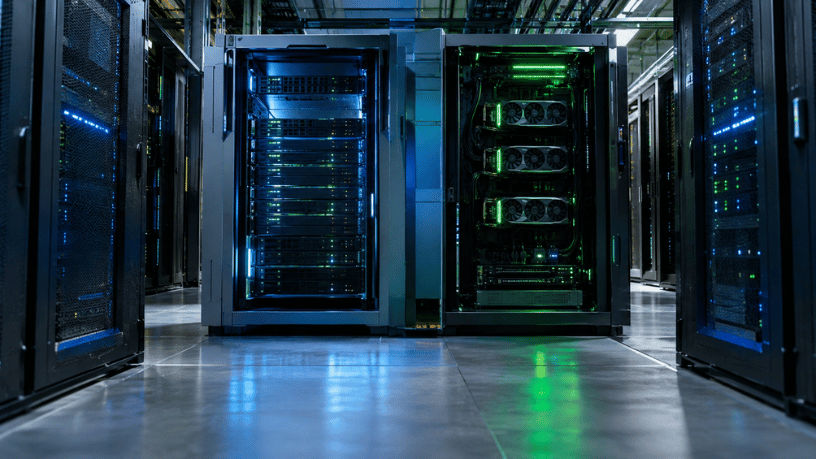
Many people believe that a server that works well for a website is also good for training an artificial intelligence model. According to Jean Pierre Lessa e Santos Ferreira, chief technology officer, that equivalence does not hold up, because a regular system and an AI workload consume resources in very different ways. Comparing the two worlds helps clarify where investment really needs to go.
Regular Processors and Accelerators: What Changes in the Computation?
A traditional system, such as an online store or a management system, handles many small, independent requests, and general-purpose processors are well suited to that task. AI workloads do something else: they multiply enormous tables of numbers over and over, and that is where accelerators come in, such as graphics cards (GPUs) and chips built specifically for this kind of calculation. An accelerator is a processor that performs thousands of simple operations at the same time, instead of a few complex operations in sequence.
The difference can be compared to a restaurant kitchen. A skilled cook can prepare any dish, but to peel a thousand potatoes, an entire crew working in parallel finishes much sooner. Parallelism explains why training models on regular processors tends to be slow and expensive, while routine tasks continue to be well served by them.
Training and Using a Model: Two Distinct Demands
Within AI itself, there are two phases with different requirements. Training is the period in which the model learns from large volumes of data, and it usually requires many accelerators working together for long periods, with intense spikes in consumption. Inference is the phase in which the finished model answers questions or makes predictions, and what matters most there is response time, the number of simultaneous requests, and the cost of each response.
As Jean Pierre Lessa e Santos Ferreira explains, treating the two phases as one leads to mistakes in sizing: those who plan infrastructure thinking only about training may end up with idle capacity later, and those who think only about inference may find they cannot train anything new. In companies that use AI continuously, both needs tend to coexist and compete for budget.
Data, Network, and Storage: The Less Visible Bottlenecks
There is a tendency to look only at the accelerator, as if it solved everything. In practice, a powerful chip sits idle if data arrives slowly. AI workloads move large volumes of information between storage, memory, and processors, and a slow internal network or poorly chosen storage turns expensive equipment into an underused resource. For that reason, the conversation about AI infrastructure involves both the speed of the connection between machines and the format and organization of the data.
Power and cooling also come into play. Equipment that runs close to its limit gets very hot and consumes a lot of electricity, and this weighs as much on the choice of location as on the monthly bill. In data centers that house AI workloads, the electrical and cooling designs stop being behind-the-scenes details and begin to limit how many machines can operate in the same space.
Choosing Between the Cloud and In-House Infrastructure
The decision about where to run these workloads is usually treated as a technical one, but it is also financial. The cloud makes it possible to rent accelerators by the hour, without buying equipment, which favors experiments and demands that vary widely. In-house infrastructure, on the other hand, requires a high upfront investment, a specialized team, and a renewal plan, because this type of equipment ages quickly.
According to Jean Pierre Lessa e Santos Ferreira, the starting point is the predictability of the workload: when usage is constant and high, the math tends to flip, and when it is irregular, the flexibility of the cloud usually weighs more. In many organizations, the middle path, with part of the work in one environment and part in the other, ends up being the most balanced, as long as there is clear control over costs and over who accesses what.
When Growth Starts to Cost More Than Expected
The last point of comparison is how cost behaves over time. In a regular system, doubling the number of users usually increases spending in a relatively predictable way. In AI, consumption per response can vary considerably depending on the size of the model and the complexity of the request, and the bill grows in a less linear way. Those who do not track this indicator from the start tend to be surprised when usage becomes widespread.
As Jean Pierre Lessa e Santos Ferreira observes, measuring cost per use and response time early on keeps a promising solution from becoming unviable when it scales. Besides, the reasoning applies to any organization: before buying capacity, it is worth understanding the workload, separating training from inference, looking at data and network with the same attention given to chips, and defining how much each response can cost without compromising the business.