
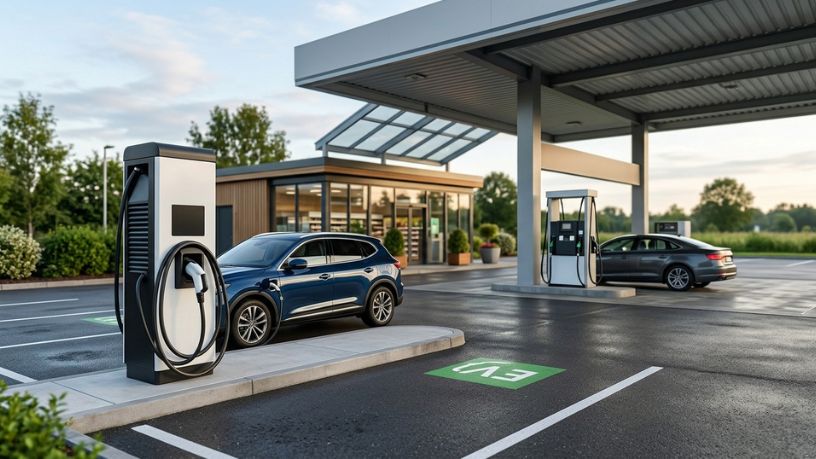
Gas station attendants have always been drivers’ first point of contact at service stations, and this role takes on greater importance with the arrival of electric vehicles. As noted by the commercial team at Rede GTB, one of Rio de Janeiro’s most established fuel retailers, drivers who recharge their batteries spend more time on-site, ask technical questions, and expect reliable guidance. This waiting period creates a commercial opportunity that traditional refueling has never offered those working on the forecourt.
However, making the most of this opportunity requires specific preparation. Training should cover the basics of charging, introduce complementary services, and develop a consultative approach without applying pressure. When training follows a clear routine, service quality improves and the station strengthens its relationship with customers. Below, we outline how to structure this training program in practice.
Who Is the Electric Vehicle Customer, and What Do They Expect from the Station?
Electric vehicle drivers tend to do their research before leaving home. They know their vehicle’s range, compare connector types, and arrive with questions about charging time, cost, and compatibility. For this reason, a vague answer from an attendant can immediately undermine their confidence. According to Rede GTB, these customers value accuracy, efficiency, and transparency more than generic friendliness. Providing good answers, therefore, requires prior preparation.
Another relevant factor, according to Rede GTB’s commercial team, is the length of the visit. While the battery charges, drivers may want to wash their vehicles, check tire pressure, have a coffee, or take care of an errand. This waiting period naturally creates an opportunity to showcase services, provided that staff identify the right need and offer the appropriate solution at the right time without disrupting the customer’s routine. Listening, therefore, comes before selling.
Training Content for the New Customer Service Profile
The training program should focus on what attendants will face in their day-to-day work on the forecourt. Rather than overwhelming them with theory, the content should combine technical knowledge, communication skills, and safety awareness. With that in mind, the following modules provide a solid foundation for any station looking to grow.
- Charging fundamentals: connector types, power levels, estimated charging times, and the difference between slow and fast charging;
- Electrical safety: operating rules, area signage, and procedures for handling malfunctions or driver questions;
- Consultative communication: active listening, open-ended questions, and simple language for explaining technical terms;
- Service portfolio: car washing, tire pressure checks, convenience services, and maintenance partnerships suited to electric vehicles;
- Service documentation: recording recurring questions to inform future training sessions.
These five areas complement one another. Technical knowledge gives attendants confidence, communication turns that knowledge into useful guidance, and the service portfolio connects customer needs with concrete offerings. Ultimately, as Rede GTB emphasizes, staff who master these areas can guide conversations naturally and avoid improvisation that undermines the customer experience.

How Can Attendants Sell Services Without Pressuring Customers?
Consultative selling begins with a question, not an offer. For example, an attendant who asks when the driver last checked their tire pressure can identify a need before suggesting the service. This approach changes the customer’s perception, making the interaction feel helpful rather than commercially pushy. It also reduces rejection, according to Rede GTB’s commercial team. As a result, conversion rates improve through trust.
Electric vehicles also change the service catalog. Tires experience different wear patterns because of battery weight and instant torque, which makes more frequent inspections worthwhile. In addition, interior cleaning fits naturally into the waiting period. Attendants should therefore understand these details so they can recommend each service with a simple technical explanation, always respecting the customer’s decision and recording the results of each approach to refine the service script.
Hands-On Training and Continuous Monitoring on the Forecourt
Without practice, the impact of training fades. Customer service simulations involving real questions from drivers help attendants build confidence before interacting with the public. Short review meetings can then highlight what worked and what needs to change, according to Rede GTB. Simple metrics, such as customer satisfaction and the number of services purchased per interaction, can also guide subsequent training cycles.
Well-Trained Staff Turn the Forecourt into a Trusted Destination
In conclusion, training attendants to serve electric vehicle drivers means expanding their role, not replacing it. With technical knowledge, attentive listening, and offers tailored to each customer’s needs, stations can turn charging time into stronger relationships and additional revenue. In this way, every well-handled conversation reinforces the brand. Stations that begin training their teams now will be better positioned when electric vehicles become a dominant presence on the roads.