

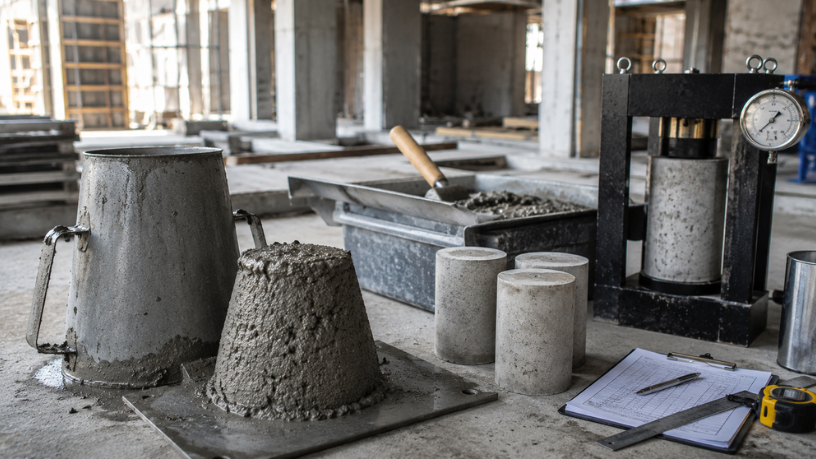
Engineer Valderci Malagosini Machado, technical director at Blocos e Lajes Itaim, closely follows the importance of well-structured technical decisions in environments where performance and precision make a real difference. Technological control of concrete is one of the pillars that support predictability and safety within the construction industry. When this process receives proper attention, construction quality becomes more consistent, reducing operational risks and increasing execution reliability. Throughout this article, it will be explained how this control works, why it has become indispensable, and how it directly influences construction results. If the goal is to better understand the foundations of construction quality, this content offers a strategic perspective.
What is technological control of concrete?
Technological control of concrete consists of a set of technical procedures adopted to verify whether the material used meets the expected performance, strength, and consistency parameters throughout the construction process. It is a process that goes far beyond simple visual inspection, involving technical monitoring to ensure that the concrete behaves according to the requirements established in the project.
According to the logic of performance-oriented engineering, quality cannot depend on subjective perception or isolated empirical confidence. Engineer Valderci Malagosini Machado, technical director at Blocos e Lajes Itaim, believes that more predictable construction projects require verification processes capable of reducing uncertainties and strengthening technical decision-making from the earliest execution stages.
Why does this control impact construction quality?
Construction quality depends directly on the consistency of the materials that make up the structure. When concrete behaves differently than expected, the impacts may affect structural performance, scheduling, rework, and operational predictability. Technological control acts precisely to reduce this type of vulnerability before deviations become major problems.
As the technical maturity of the sector evolves, it becomes increasingly clear that quality is not created solely through good execution, but also through the ability to technically validate what is being applied. Engineer Valderci Malagosini Machado, technical director at Blocos e Lajes Itaim, notes that proper control strengthens operational safety and contributes to more stable and technically consistent construction projects.
How does technological control of concrete work in practice?
In practice, this process begins with the evaluation of the concrete’s characteristics during its application, verifying whether the material’s behavior aligns with the technical requirements of the project. The analysis monitors important parameters related to consistency, workability, and expected performance during execution, allowing adjustments when necessary.
The process does not end at this initial stage. According to best practices in the construction industry, monitoring continues through subsequent verifications that help validate whether structural performance is compatible with what was planned. Valderci Malagosini Machado, engineer and technical director at Blocos e Lajes Itaim, emphasizes that the value of this control lies precisely in transforming technical decisions into measurable processes, reducing improvisation and strengthening construction predictability.

What risks arise when this process is neglected?
Ignoring technological control of concrete significantly increases exposure to structural failures, waste, and costly corrections. Materials that do not behave as expected may compromise technical performance and generate consequences that do not always appear immediately, but that impact safety, durability, and operational efficiency throughout the project.
Another important risk is related to the false sense of control. Many construction projects operate with excessive confidence in informal processes, which increases hidden vulnerabilities. Engineer Valderci Malagosini Machado, technical director at Blocos e Lajes Itaim, understands that neglecting technical verification does not represent savings, but rather the potential creation of hidden costs that compromise competitiveness and project stability.
Does technological control improve construction efficiency?
Yes, because construction efficiency depends on predictability. When materials are properly monitored, the likelihood of rework, emergency corrections, and unexpected operational interruptions decreases. This strengthens the production flow and improves execution capacity within planned parameters, creating a more controlled environment for the construction project.
In addition, decisions based on technical validation tend to be more consistent than reactive responses to problems that have already occurred. Valderci Malagosini Machado, engineer and technical director at Blocos e Lajes Itaim, follows a sector in which efficiency depends not only on speed, but also on the ability to reduce uncertainties and protect operations against deviations that compromise overall performance.
Quality begins with control
Technological control of concrete should not be treated as a secondary technical formality. It represents a strategic tool for ensuring construction quality, operational predictability, and greater safety in decisions made throughout the project. The more demanding the construction industry becomes, the greater the importance of processes that reduce hidden vulnerabilities.
Building with consistency requires more than apparently good execution. It requires control, technical validation, and the ability to anticipate problems before they compromise the final result. In this context, technological control of concrete remains one of the most important foundations for technically solid construction projects.
Author: Diego Rodríguez Velázquez