

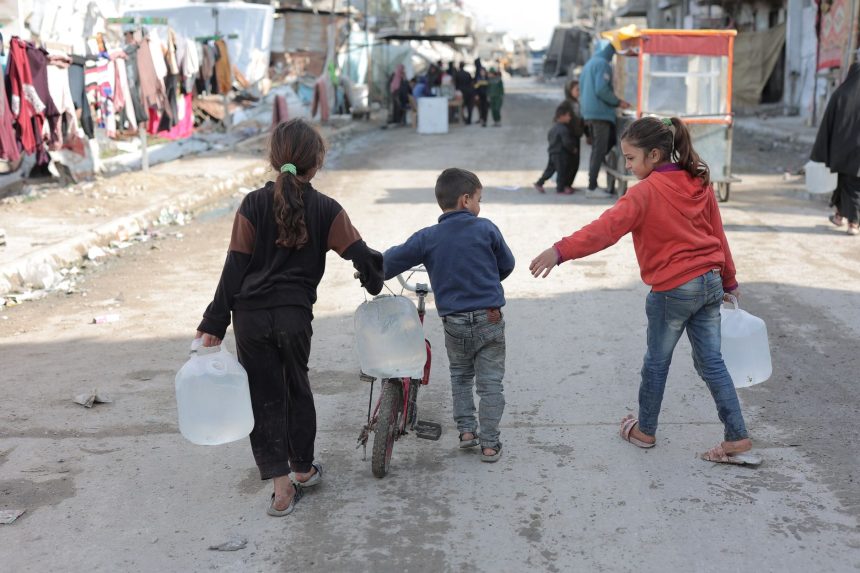
Aid shortages are emerging as one of the clearest signs that Gaza’s humanitarian emergency remains unresolved three years after the Hamas attack on Israel. Although the United States has presented a peace plan, continued strikes, restricted access for relief supplies and a major funding gap are limiting the ability of humanitarian organizations to respond to the needs of the Palestinian population.
The conflict began after Hamas attacked Israel on October 7, 2023. Since then, the Gaza Strip has faced extensive destruction, mass displacement and the collapse or weakening of essential services. A report published by Agência Brasil, drawing on United Nations humanitarian data, said bombing was still affecting densely populated areas at the end of September 2026.
Humanitarian response remains underfunded
The financial resources available for emergency assistance remain far below the amount requested. According to the information reported by Agência Brasil, only 40% of the $4 billion sought for aid to the Palestinian population had been transferred. The shortfall affects the ability to provide food, shelter, medical care and other forms of support to people who have been living through prolonged displacement and insecurity.
Funding is particularly important in Gaza because humanitarian needs are not limited to a single emergency. Families require regular access to food and health services, while damage to housing and infrastructure increases their dependence on external assistance. When contributions fall short, aid agencies face difficult choices over which needs can be covered and which must remain unmet.
The United Nations humanitarian assessment cited in the report estimated that approximately 1.4 million people, or about 67% of Gaza’s population, could experience acute food insecurity between July and December 2026. The projection illustrates the scale of the crisis even as diplomatic efforts continue and discussions focus on the next phase of the conflict.
Violence continues despite diplomatic efforts
The persistence of military operations remains another obstacle to the implementation of the peace plan. Between September 23 and 30, 2026, 29 Palestinians were killed and 147 were injured, according to figures from Gaza’s Health Ministry reproduced by Agência Brasil. The data points to the continuing risks faced by civilians in an area where population density is high and safe movement remains difficult.
For residents, the combination of airstrikes and limited aid creates a crisis that cannot be addressed through diplomacy alone. A peace framework may establish political objectives, but its effectiveness depends on whether violence decreases, humanitarian access expands and the parties agree on mechanisms capable of protecting civilians.
The situation also highlights the gap between the announcement of a peace initiative and its practical implementation on the ground. As long as bombardments continue and relief deliveries remain restricted, the population’s immediate needs are likely to remain central to any discussion about Gaza’s future.
Disputes complicate the peace plan
Several unresolved issues are blocking progress. One of the main disputes concerns the disarmament of Hamas, a demand that has not been reconciled with the group’s role in the territory and the broader security concerns raised by Israel. Another point involves the continued presence of Israeli forces in parts of Gaza, which remains connected to questions about security, territorial control and the conditions for a lasting ceasefire.
The creation of a civilian administration is also uncertain. Establishing a governing structure for Gaza would require agreement over who would manage public services, security and reconstruction. Without a defined administration, international assistance and recovery efforts face additional political and logistical challenges.
These disagreements make the humanitarian crisis inseparable from the diplomatic process. Food insecurity, displacement and medical needs are immediate issues, but their resolution depends partly on political decisions about security, governance and the future of the territory.
A crisis with regional and international consequences
Gaza remains a central issue in international diplomacy because the conflict involves Israel, Palestinian organizations, the United States, the United Nations and countries across the Middle East. The humanitarian situation has also intensified debates over international law, civilian protection and the responsibilities of governments involved in negotiations or assistance.
The United States has presented the peace plan, but its implementation requires cooperation among actors with conflicting objectives. The continued lack of agreement over weapons, military deployments and civilian administration means that the proposal has not yet translated into a stable arrangement for Gaza’s residents.
Three years after the start of the war, the humanitarian indicators show that the emergency is far from over. Continued attacks, insufficient funding and the risk of widespread food insecurity are combining to keep millions of Palestinians dependent on aid. Until the political disputes are addressed and humanitarian access improves, the prospect of a durable recovery will remain limited.